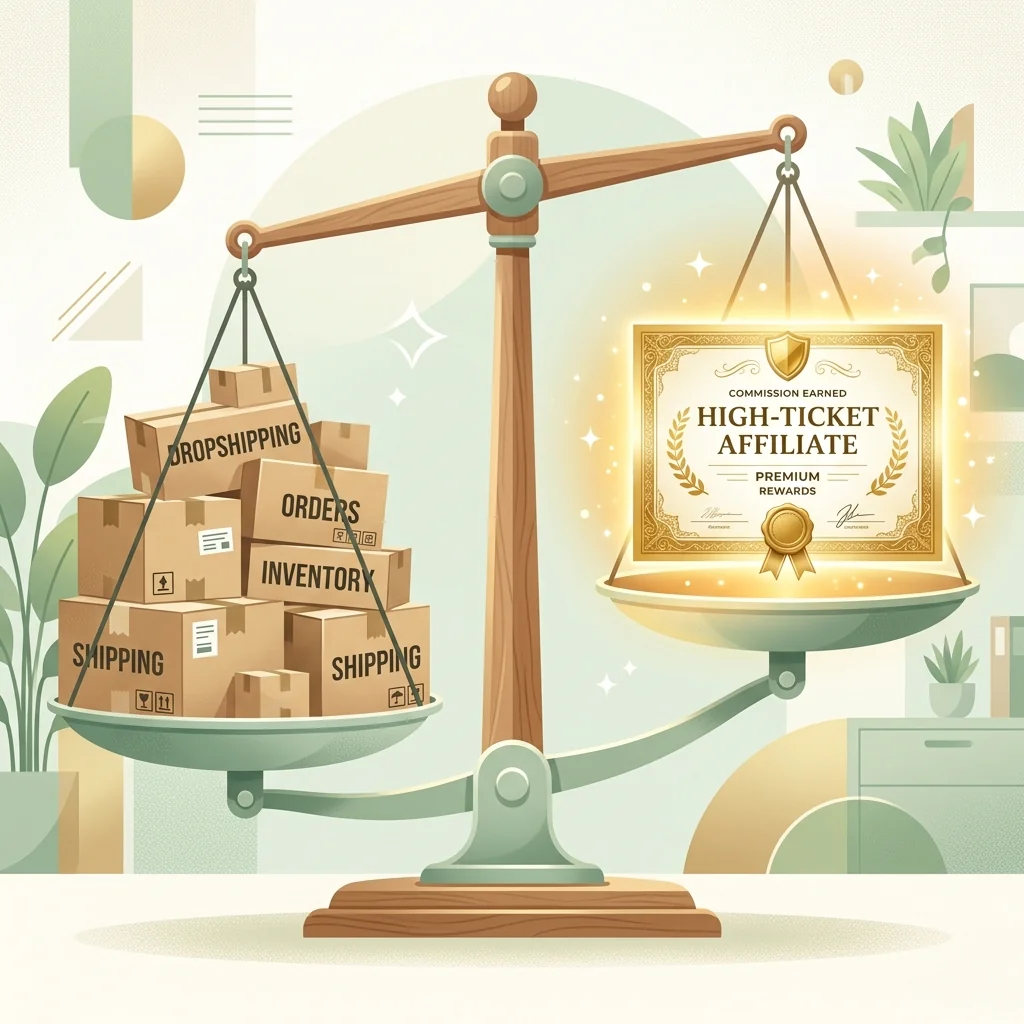
If you are looking to build a profitable digital business in 2026, you have likely come across two “titans” of the industry: High-Ticket Affiliate Marketing and Dropshipping. Both models promise the dream of location independence and high income, but they are fundamentally different in how they operate, how they scale, and most importantly, how they impact your Return on Investment (ROI).
At Digital Success Lane, we have seen thousands of entrepreneurs struggle to choose between these two paths. One path promises control; the other promises simplicity. One path requires you to be a merchant; the other requires you to be an authority.
Today, we are going to dive deep into the comparison. We will look at the profit margins, the risks, and why how-to-start-high-ticket-affiliate-marketing might be the most efficient path to $10k/month in 2026.
The Operational Reality: Servant vs. Master
Before we look at the numbers, let’s look at the “lifestyle” of each business.
Dropshipping: The Merchant’s Mission
In a dropshipping model, you are the face of the business. You choose the products, you build the store, you run the ads, and most importantly, you handle the customers.
- The Good: You own the customer data. You can remarket to them forever. You have full control over the branding and the pricing.
- The Bad: You are responsible for everything. If the supplier in another country sends a broken item, *you* are the one who gets the angry email. *You* are the one who has to process the refund. In 2026, customer expectations are higher than ever, and managing this support can quickly become a full-time job.
High-Ticket Affiliate Marketing: The Authority’s Approach
In high-ticket affiliate marketing, your role is different. You are a professional “matchmaker.” You identify a high-value problem and point your audience toward a world-class solution.
- The Good: You have zero operational overhead. No inventory, no shipping, no customer support. Once the sale is made, your work is done. You receive a “clean” commission.
- The Bad: You don’t own the product or the final customer data (unless you capture it on your lead page). Your success is dependent on the stability and quality of the merchant you are promoting.
Profit Margins and ROI: The Search for ‘Clean’ Income
This is where the models truly diverge.
In Dropshipping, your gross margins might look impressive (30-50%). But when you factor in the cost of goods sold (COGS), the shipping fees, the platform costs (Shopify, etc.), and the massive ad spend required to compete, your *net* profit often fluctuates between 10% and 25%. One “bad” week of ad performance or a batch of faulty products can wipe out your monthly profits.
In High-Ticket Affiliate Marketing, your commission percentage is often lower (5% to 20% for physical goods or high-end services, though high-ticket-saas-affiliate-marketing-strategy can offer 30-40% recurring). However, your ROI is significantly higher because your expenses are minimal. You don’t have COGS. Your main investment is your time for content creation and a small budget for tools and hosting. Every dollar of commission is a dollar that mostly goes straight to your bottom line.
Risk Management: The Fear Factor
High-ticket affiliate marketing is inherently a lower-risk model. If a niche becomes oversaturated or a product loses its appeal, you can switch offers in an afternoon. You haven’t invested thousands in inventory or custom packaging.
Dropshipping carries “Systemic Risk.” You are at the mercy of your suppliers’ quality control and the shipping time of international carriers. In the 2026 economy, supply chain disruptions are common. If your supplier disappears, your entire business vanishes overnight. This risk is why we often recommend affiliate marketing to those looking for a “cleaner” and more stable business model.
Scalability: Compounding Content vs. Complexity
Both models are highly scalable, but the *method* of scaling is different.
- Scaling Dropshipping: This is often done through “Ad Brute Force.” You spend more on ads to get more traffic. As you scale, you must hire virtual assistants to handle the increased customer support volume and manage the more complex logistics. It becomes an “Operations Game.”
- Scaling High-Ticket Affiliate Marketing: This is an “Authority Game.” You scale by building-authority-site-for-high-ticket-affiliate-marketing. Your content compounds over time. A video you made a year ago continues to drive high-intent leads today without any additional cost. You don’t need a team of VAs; you just need to continue providing world-class insights in your best-high-ticket-affiliate-marketing-niches.
Quality Control: The Trust Moat
In high-ticket marketing, trust is your only moat.
In Dropshipping, you are often selling products you have never touched. You choose the products, you build the store (often on platforms like Shopify), you run the ads, and most importantly, you handle the customers.
In Affiliate Marketing, you can spend your time vetting the absolute best products in the world. You can choose to promote only brands with a 4.5+ rating on Trustpilot. You are leveraging *their* billion-dollar infrastructure and *their* reputation to build yours.
Ad Spend and Platform Dependencies: The Fragility of Traffic
One of the most overlooked differences between these models is how they handle traffic.
- Dropshipping is often ‘Ad-Dependent’. Most dropshippers rely on Facebook, Instagram, or TikTok ads to drive their sales. This means you are at the mercy of their algorithms. If your ad account gets banned or your CPMs (Cost per thousand impressions) double overnight, your entire business can become unprofitable in 24 hours.
- High-Ticket Affiliate Marketing is ‘Asset-Dependent’. While you *can* use ads, most high-ticket success is built on SEO and authority content. This traffic is much more stable. A blog post that ranks #1 for a high-intent keyword provides “free” traffic for months or years. You aren’t buying traffic; you are building an audience.
This stability is a key differentiator in the 2026 market. We teach our partners at Digital Success Lane to build assets that *they* own, rather than renting their success from a billionaire’s ad platform.
Customer Data Rights and the Burden of Privacy Compliance
In 2026, privacy is not just a policy; it is a legal minefield.
- Dropshippers are data controllers. You are responsible for the safe handling of customer names, addresses, and credit card information. You must be compliant with GDPR, CCPA, and a host of other international regulations. This requires legal advice, secure servers, and a robust data protection strategy. If you fail to protect this data, the fines can be catastrophic.
- High-Ticket Affiliates are generally data processors or even just “referrers.” In many cases, you never even see the customer’s private data. They interact with the merchant’s secure checkout. This drastically reduces your legal liability and your operational headache.
This “Low Liability” aspect is another reason why how-to-start-high-ticket-affiliate-marketing is the preferred model for the solo-entrepreneur. You can focus on the growth without worrying about the legal fine print of a global logistics operation.
The Hybrid Model: The Path of the Future
I promised to discuss which is “better,” but the truth is that many of the most successful marketers in 2026 use a Hybrid Model.
They start with building-authority-site-for-high-ticket-affiliate-marketing. They build their audience and identify exactly which problems that audience is willing to pay to solve. Once they have a consistent stream of affiliate income, they identify a gap in the market.
- Maybe there is a physical product that would solve their audience’s problem better.
- Maybe they want to transition from being an affiliate to being a “Brand Owner.”
By starting as an affiliate, you “test the waters” with someone else’s money and risk. You learn the market inside and out. Then, and only then, do you transition into dropshipping or private labeling your own products. This “Affiliate-First” approach is our secret sauce for long-term ROI. It ensures that when you finally *do* launch your own store, you already have a loyal audience ready to buy.
A ‘Day in the Life’ Comparison
To help you choose, let’s look at a typical Tuesday:
The Dropshipper:
- 08:00: Checks ad performance from last night. Adjusts budgets.
- 10:00: Communicates with suppliers about a delayed shipment to the UK.
- 13:00: Answers 15 customer support tickets about “where is my order?”
- 16:00: Scours TikTok for “the next winning product” because their current one is dying.
- 20:00: Re-films a new creative for their Facebook ads.
The High-Ticket Affiliate:
- 08:00: Checks traffic growth in Search Console.
- 10:00: Writes 1,000 words of a new “comparison guide” in one of their best-high-ticket-affiliate-marketing-niches.
- 13:00: Responds to a few deep-dive questions in their private Discord community.
- 15:00: Records a 10-minute “walkthrough” of their favorite new B2B tool.
- 17:00: Closes the laptop. No shipments to worry about. No support tickets.
Which day sounds more like the freedom you are chasing? At Digital Success Lane, the choice is clear.
Final Verdict: The ROI of Freedom
While dropshipping can lead to a larger “exit” (selling the brand), high-ticket affiliate marketing leads to more immediate and “stress-free” ROI. It allows you to stay lean, stay creative, and stay profitable without the weight of an e-commerce empire on your shoulders.
If you value your time and your sanity, high-ticket affiliate marketing is the better vehicle. If you want to build the next Walmart, start dropshipping. One path leads to a business you run; the other leads to a business that runs you.
Closing Thoughts
Whether you choose affiliate marketing or dropshipping, the key to success is the same: providing more value than your competition. Don’t look for the “easy” way; look for the “efficient” way.
High-ticket affiliate marketing offers a level of efficiency and ROI that is hard to match in the modern digital landscape. By focusing on high-value niches and building undeniable authority, you can create a business that provides true freedom without the operational weight of a traditional e-commerce store. It is time to choose your lane and start driving toward your digital success. We will be right here to help you navigate every turn.
Leave a Reply