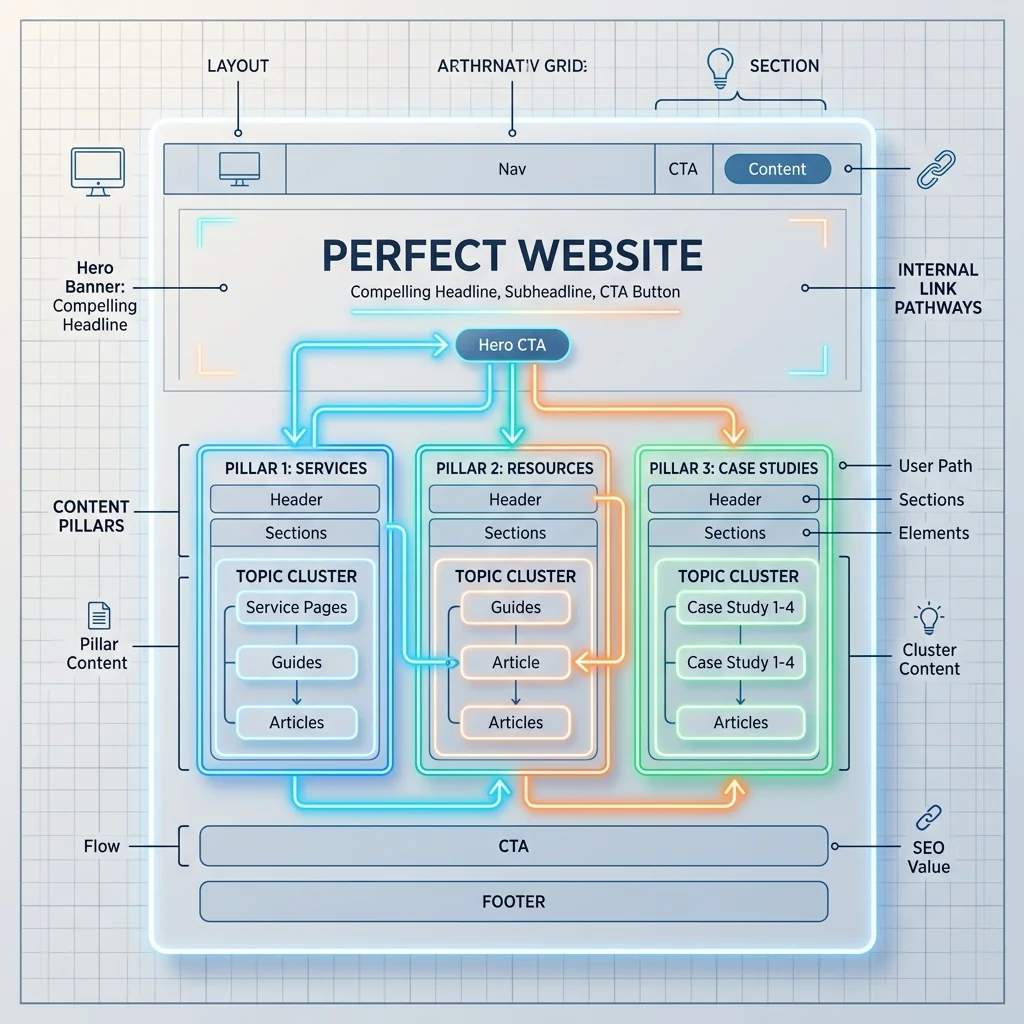
Architecture matters more than volume. If you’ve been in the startup game for a while, you’ve probably seen the ‘Content Graveyard’ – a blog full of 500-word posts that rank for nothing, say nothing, and convert no one. In, the strategy is no longer about how much you publish; it’s about how you organize what you know. This is where the ‘Ultimate Guide to Pillar Page SEO Strategy’ becomes your most powerful competitive weapon.
Most founders think SEO is about picking a keyword and repeating it until Google notices. But modern search engines – and the new wave of AI answer engines like Gemini and Perplexity – don’t look for words; they look for Topical Authority. They want to see that you are an ‘Industry Architect,’ not just a ‘Noisy Distraction.’ By building high-authority pillar pages, you create a digital fortress of expertise that is difficult to copy and easy to reward. This starts with how you define your content pillars.
The Hub-and-Spoke Blueprint: Why Structure Wins
The core of any pillar page strategy is the ‘Hub-and-Spoke’ model.
- The Pillar (The Hub): A comprehensive, 2,000+ word resource that covers a broad topic in depth. It is the central nervous system of your authority.
- The Clusters (The Spokes): Specific, focused articles that explore narrow niches within that broad topic. They provide the ‘Connective Tissue’ between your expertise and Sarah’s (your persona’s) specific questions.
- The Glue (Internal Linking): A bidirectional linking system that tells search engines exactly how your information is connected. This is the ‘Force Multiplier’ of your SEO strategy.
When you link your pillar to your clusters and vice versa, you create a self-reinforcing ‘Authority Loop.’ Every time a cluster post ranks for a niche term, it ‘shares’ that power with the main hub. This is the most effective way to boost your SEO authority in high-competition environments. According to the Content Marketing Institute (CMI), structured hubs are 2.5x more likely to sustain top-tier rankings compared to chronological blogs.
Beyond Keywords: Semantic Optimization (NLP)
In, search engines use Natural Language Processing (NLP) to understand the *meaning* behind Sarah’s query. They aren’t looking for exact string matches; they are looking for ‘Entities’ and ‘Semantic Relationships.’
To optimize your pillar page for this new era:
- Entity Identification: Clearly define the core concepts, brands, and tools in your industry.
- Topical Completeness: Don’t just answer the ‘main’ question. Answer the ‘next’ question Sarah is likely to ask. Use modern optimization tools to find these semantic gaps and fill them before Sarah even knows she has them.
- LSI Expansion: Use naturally related terms. If you’re writing about ‘SEO,’ you should naturally be talking about ‘Search Intent,’ ‘Crawl Budget,’ and ‘Backlink Profiles.’
The “10x Rule” of Authority construction
A pillar page should not be ‘good.’ It must be ‘Irreplaceable.’ If a reader could find the same information on 10 other sites, you haven’t built a pillar; you’ve built a placeholder.
The 10x Rule means your page is:
- 10x more visual: Use original infographics, proven data visualizations, and custom screenshots. Readers process visual information 60,000x faster than text.
- 10x more practical: Include downloadable templates, calculators, or real-world startup case studies. Give Sarah a tool she can use today, not just a philosophy she can read.
- 10x more authoritative: Cite reputable external sources like HubSpot or Statista to anchor your claims in verifiable data.
Architecting for AI Retrieval (GEO)
We are moving past SEO into GEO: Generative Engine Optimization. AI models like Claude and ChatGPT search for ‘concise experts’ to cite as their sources. To make your pillar page ‘Cite-able’ by an AI:
1. Clear Hierarchy: Use H2 and H3 tags effectively to create a machine-readable ‘Map’ of your knowledge. Machines love structure.
2. Direct Answer Paragraphs: Start every major section with a 1-2 sentence ‘summary’ that answers the core problem directly. This is the ‘Snippet’ the AI will grab.
3. Structured Data (Schema): Use FAQ and Article schema to label your expertise for the crawlers so they don’t have to guess what your page is about.
The Strategy for Strategic Deployment
Don’t just launch a pillar and hope for the best. You need a dedicated deployment roadmap:
- Phase 1: Research. Use advanced keyword tools to identify the ‘Head Term’ with the highest business intent and lowest ethical risk.
- Phase 2: Construction. Draft the pillar as the ‘Definitive Guide.’ Ensure the brand voice is consistent across the entire 3,000+ words.
- Phase 3: Cluster Expansion. Write 5-10 supporting ‘Spoke’ blog posts that link back to the hub. These spokes are your ‘Early Warning System’ for ranking.
- Phase 4: Maintenance. Audit and refresh the page every 6 months to signal ‘Freshness’ to search engines. Maintaining your pillars is what separates the winners from the ‘one-hit wonders.’
UX and the Conversion Loop
A pillar page that gets traffic but zero leads is a failed investment. You must balance SEO with UX:
- Navigation: Use a ‘Sticky Table of Contents’ to help Sarah jump to the section she needs without getting lost in the deep-dive content.
- Ungated Depth: Give away 90% of the value for free. This builds the trust required to ask for the other 10% (the lead magnet or demo).
- Contextual CTAs: Don’t just put a button at the bottom. Embed relevant offers within the flow of the social media strategy or technical sections where the intent is highest.
Why Speed and Scale Matter in
In, the shelf life of ‘average’ content is shrinking. To stay ahead, you must learn to scale your production without losing the ‘high-authority’ signature that makes your brand unique. This often involves a Human-in-the-Loop AI strategy where machines handle the mapping and humans handle the expertise. Speed of implementation is now a competitive advantage.
Brief Summary: Building for 2027 and Beyond
The future of search belongs to those who own the ‘Knowledge Graph’ of their industry. By committing to a pillar page SEO strategy today, you are not just optimizing for a search engine; you are building a foundational business asset. You are creating a ‘Source of Truth’ that humans will trust and AI will cite. Stop chasing the short-term sugar high of random viral posts and start building the enduring architecture of authority. Your strategy depends on this consistency.
Final thoughts on architectural SEO: in a world of infinite noise, clarity is the ultimate luxury. Your pillar page is the beacon that provides that clarity. Whether you are building a freelance portfolio or a global SaaS, your pillars are your legacy. Don’t build them on digital shifting sand; build them on the solid rock of high-authority strategy. Start your construction today.
Deep Dive: The Technical Audit for 2026
As we approach the mid-2020s, the technical requirements for a pillar page have stabilized around five core pillars of performance. If you are missing any of these, you are leaving authority on the table.
1. The Page Load Authority: In an age of instant AI answers, a pillar page that takes more than 2 seconds to load is effectively invisible. Optimize your images, prune your scripts, and use a high-performance CDN. Your ‘Core Web Vitals’ are not just a developer metric; they are a trust signal for Sarah.
2. The Mobile-First Architecture: 70% of your audience (including Sarah) will likely discover your pillar on a mobile device while commuting or between meetings. If your ‘Sticky Table of Contents’ doesn’t work on a thumb-sized screen, you’ve lost the user journey.
3. The Schema Web: Your pillar should be wrapped in ‘JSON-LD’ structured data that explicitly links the ‘Author’ (an expert) to the ‘Organization’ (your startup) and the ‘Topic’ (your authority). This creates a ‘Machine-Readable Trust Graph’ that AI models prioritize during retrieval.
4. The “Freshness” Signal: Google and Gemini look for the ‘Last Modified’ date to be recent, but they also look for a ‘Semantic Delta’ – actual new information added to the page. Simply changing the date isn’t enough; you must add a new startup case study or a fresh data point from Socialinsider to prove you are still monitoring the river of information.
5. The Multimedia Moat: Text alone is no longer enough to win the authority game. Every pillar should include at least one ‘interactive element’ – a quiz, a calculator, or an embedded video summary. This increases ‘Dwell Time’ and tells the algorithm that your page is a high-value destination, not just a wall of text.
The Psychology of Architectural Authority
Why do humans trust long-form pillar pages? It’s about ‘Cognitive Ease.’ When Sarah sees a comprehensive, well-organized resource that covers all her bases, her brain releases the tension of the ‘Information Search.’ She stops looking for other answers because she feels she has found the ‘Source.’
This psychological win is the foundation of long-term brand loyalty. By providing Sarah with a ‘Structural Map’ of her problem, you move from being a ‘Solution Vendor’ to being a ‘Strategic Guide.’ This is the ultimate goal of the pillar page SEO strategy.
Future-Proofing for 2028: The Autonomous Authority Engine
Looking forward, the startups that dominate will be those that use AI to live-update their pillars based on real-time search trends and community conversations. Your pillar page will become a ‘living entity’ that adapts its content to the current industry climate. To prepare for this, build your pillars with modularity in mind today. Keep your ‘Atomic Insights’ separate from your ‘Time-Sensitive Data’ so that maintenance and updating can be automated.
Stop building ‘One-Off Blog Posts’ and start building a Scalable Intelligence Engine. Your brand’s survival in the Augmentation Era depends on this structural shift. Place your cornerstone today and own your industry’s future.
Leave a Reply