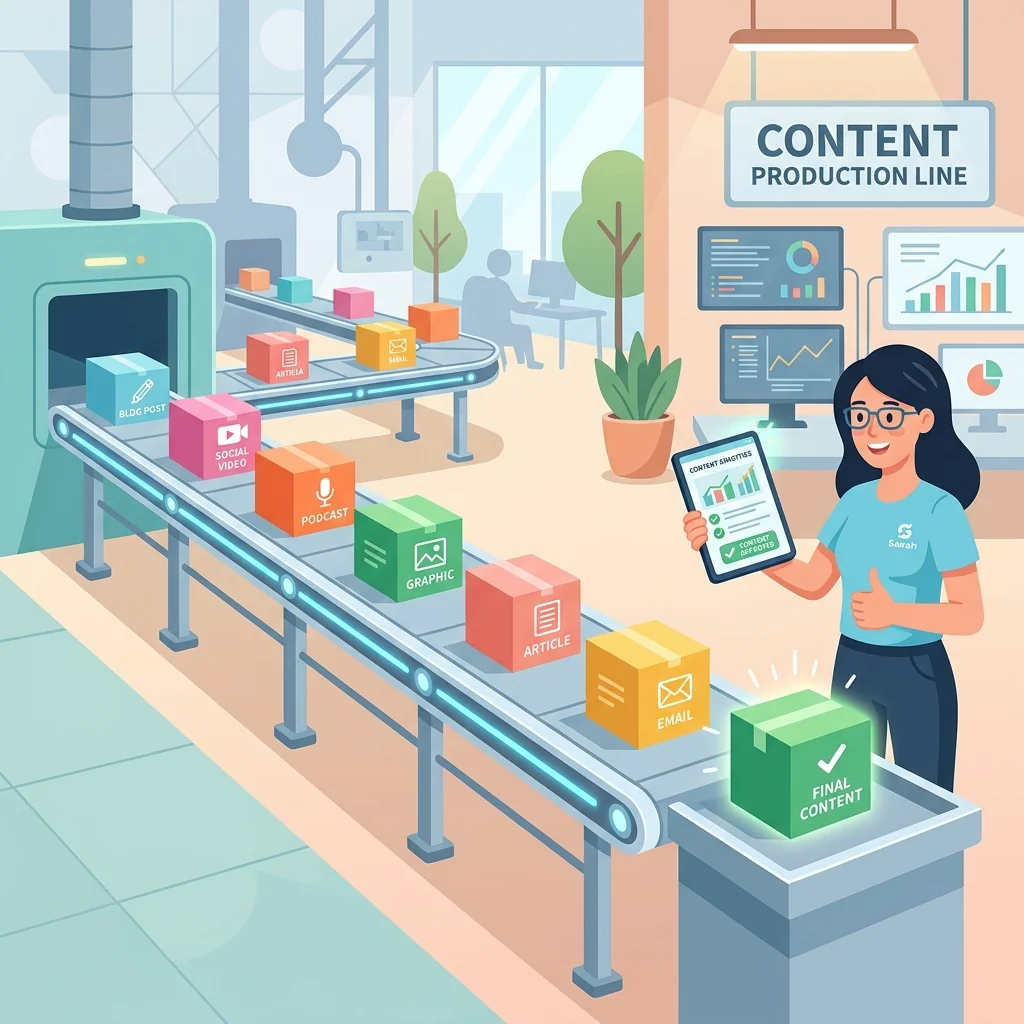
I once spent a whole weekend trying to manually rewrite twenty product descriptions for a luxury client. My brain was mush, my coffee was cold, and my creativity was at zero. That was five years ago. Today, I could do that same task – with better results – in about fifteen minutes using a properly structured prompt. But here’s the kicker: I wouldn’t just be ‘using AI.’ I’d be using a *manufacturing process* for content.
Learning how to use structured prompts for automated marketing content at scale is the single most important skill for digital marketers in 2026. The web is already being flooded with ‘AI slop’ – generic, repetitive content that everyone can see through. To stand out, you need to produce content that is high-volume AND high-quality. You need systems, not just suggestions. Today, I’m breaking down how I build those systems and why they are the engine behind my success and the growth at Digital Success Lane.
From Prompting to Process Manufacturing
Most people think of prompting as a conversation. They ask ChatGPT a question, wait for an answer, and then try again if they don’t like it. That’s fine for a one-off task, but it’s a disaster for a business. If you’re building a brand, you need your content to sound the same on Monday as it does on Friday. You need consistency.
Structured prompting is about moving from a conversation to a configuration. You’re not ‘talking’ to the AI; you’re ‘setting up’ the AI. By using a modular framework, you can ensure that every single output follows the same rules, uses the same brand voice, and hits the same SEO targets. This is how you build a real freelance portfolio building system that attracts high-ticket clients – by showing them you have a process that works. You aren’t just selling ‘writing’; you’re selling a reliable, scalable system.
The Anatomy of a Modular Marketing Prompt
I use a five-part framework for all my scaled content operations. I call it the R-C-T-C-O method. If you miss one of these, the whole thing can fall apart. I’ve spent thousands of hours refining this, and it’s the closest thing we have to a ‘cheat code’ in 2026.
1. Role (The Persona)
Don’t just say ‘writer.’ That’s like asking for ‘food’ at a restaurant. Say: ‘Act as a Senior B2B SaaS Copywriter with 10 years of experience in conversion rate optimization and a background in behavioral psychology.’ This narrow focus changes the model’s entire vocabulary and perspective. It’s the difference between a high schooler writing your ads and a pro. I’ve found that giving the persona a specific name and a brief ‘career history’ can actually improve the stylistic consistency of the output.
2. Context (The Background)
This is where you give the AI the ‘Why.’ Who is the audience? What are their pain points? What is the unique selling proposition (USP) of the product? I often feed my brand voice guidelines directly into this section. If you want to see how to integrate this with logic, check out my guide on how to use chain-of-thought prompting for complex reasoning. Context is the ‘lensing’ through which the AI sees the task. If the lens is dirty or missing, the result will be blurry.
3. Task (The Objective)
Be crystal clear. ‘Write a 1500-word blog post’ is better than ‘Write an article.’ Better yet: ‘Write a persuasive blog post that introduces a specific technical bottleneck, provides three actionable solutions using the framework provided, and ends with a strong call to action linked to our newsletter.’ The more verbs you use in the task description, the better.
4. Constraints (The Guardrails)
This is the most overlooked part. I spend more time on constraints than on the instructions. I’ll list things like: ‘Do not use words like “elevate,” “robust,” or “dynamic.”‘ ‘Stop every 200 words to check for keyword density.’ ‘Ensure the reading level is grade 9.’ This is also where you implement the best prompt architecture for minimizing AI hallucinations to keep things factual. Constraints are what prevent the AI from taking ‘shortcuts’ that ruin the quality.
5. Output Format (The Template)
Tell the model exactly what you want the code or text to look like. ‘Provide the output in Markdown format with H2 and H3 tags. Include a separate section for key takeaways and a meta-description with a maximum of 160 characters.’ If you don’t define the format, the model will pick one for you, and it’s usually the one that’s easiest for *it* to generate, not the one that’s best for *you*.
Why Productivity Stats Matter for Your Business
Recent marketing data from search industry experts suggests that teams using integrated AI workflows are seeing an average 44% increase in productivity. That’s not just a small bump; that’s a transformation. It means one person can do the work of three. In the hyper-competitive market of 2026, staying ahead isn’t about working more hours; it’s about making your hours count for more.
But the real win isn’t just speed. It’s the ability to A/B test at scale. If it only takes five minutes to generate ten variations of an ad campaign, you can test ideas that you never would have had the time for before. This is the ‘unfair advantage’ of the modern digital marketer. By using structured prompts, you’re not just working faster; you’re working smarter. You’re exploring more of the ‘creativity space’ than a human could ever do alone.
Avoiding the ‘AI Slop’ Trap with Advanced Guardrails
In 2026, about 77% of consumers say they can identify AI-generated content. If your audience feels like they’re reading a robot, they’ll stop trusting you. The fix for this isn’t to use less AI; it’s to use better prompts. We call it ‘De-Robotizing’ the output.
I’ve found that the best way to avoid ‘robotic’ text is to feed ‘Negative Constraints’ into your prompts. I have a ‘Banned Word List’ that I use for every project. It includes buzzwords that LLMs love to overuse like ‘unleash,’ ‘unlock,’ and ‘dive into.’ By cutting those out, you force the model to find more creative, human-sounding ways to express itself.
I also use ‘Variable Injection’ – I’ll purposefully insert a specific, unique anecdote or customer quote into the prompt and tell the AI to build the content *around* that real piece of data. This ‘anchors’ the content in reality and makes it feel much more authentic. If you’re building a brand, you need that ‘human spark’ to be front and center.
Multi-Persona Testing: The Secret Sauce
If I’m not sure which tone will resonate best, I don’t just guess. I use a ‘Multi-Persona Prompt.’ I’ll ask the AI: ‘Draft this landing page from three perspectives: 1. A skeptical technical engineer. 2. A results-oriented CEO. 3. A curious beginner.’
This gives me three very different drafts that I can then merge into a single, highly resonant piece of content. This kind of ‘perspective shifting’ is almost impossible for a human writer to do quickly, but for an LLM, it’s trivial. It allows you to build content that speaks to every stakeholder in the buying process simultaneously.
Scaling with Human-in-the-Loop (HITL)
Never, ever go full-auto. I’ve seen companies try to fire their entire content team and replace them with a script. It always fails. Why? Because AI has no taste. It doesn’t understand your strategy on a gut level. It doesn’t know if a joke is actually funny or just ‘logically a joke.’ A joke based on a logical pattern is rarely humorous.
The most successful operations use a ‘Hybrid Workflow.’ The AI handles the 80% – the research, the first drafts, the SEO formatting. The human provides the 20% – the strategic ‘hook,’ the final polish, and the fact-checking. This HITL approach achieved 2.4x better campaign performance in recent internal benchmarks from Gartner compared to pure automation. You want the AI to be your engine, but you always want a human at the wheel. Without that steering, you’re just driving fast into a wall.
Building and Managing Your Prompt Library
If you find a prompt that works, don’t just lose it in your chat history. Treat it like code. I keep a version-controlled repository of my ‘Golden Prompts.’ When I find a better way to structure a meta-description, I update the template. This way, if I hire a new freelancer, they don’t have to ‘learn’ how to prompt the way I do – they just use the library.
I recommend using tools like Obsidian or a shared Notion database to organize your prompts. Tag them by use case (e.g., #AdCopy, #BlogPost, #EmailMarketing) and include notes on which models (GPT-4o vs Claude 3.5) they work best with. This ‘Prompt Operations’ (PromptOps) mindset is the hallmark of a scale-ready business. It allows you to duplicate your success across dozens of different projects or clients without losing quality. If you want to win in the long term, you have to build assets, and a library of proven, structured prompts is one of the most valuable assets you can own.
Real-World Application: The Content Pipeline
Let’s map out a real content pipeline.
1. Step 1: The Research Module. A structured prompt that reads your competitors’ top 10 posts and lists the common themes and the gaps they missed.
2. Step 2: The Outline Module. A prompt that takes those gaps and builds a 10-point outline designed for maximum search intent coverage.
3. Step 3: The Drafting Module. The R-C-T-C-O prompt we discussed, used to write each section of the outline individually to avoid ‘model drift.’
4. Step 4: The SEO/Formatting Module. A prompt that adds internal links, bullet points, and checks for keyword density.
By breaking the ‘Task’ of writing into these smaller, structured ‘Modules,’ you get much higher quality than asking for a whole post at once. It’s the assembly line for the digital age.
Summary & Scale Strategy
Structured prompting isn’t about being ‘technical.’ It’s about being organized. It’s about taking the same rigor you apply to your project management and applying it to your AI interactions. By defining roles, setting context, and enforcing strict constraints, you can turn a ‘cool chatbot’ into a content-generating powerhouse. Stop asking for favors and start setting requirements. The scale you can achieve once you have these systems in place is limited only by your imagination – not your time. Once you master this, you’ll find that your capacity for work increases tenfold. Let’s start building your content engine today and see how far we can take it.
Leave a Reply