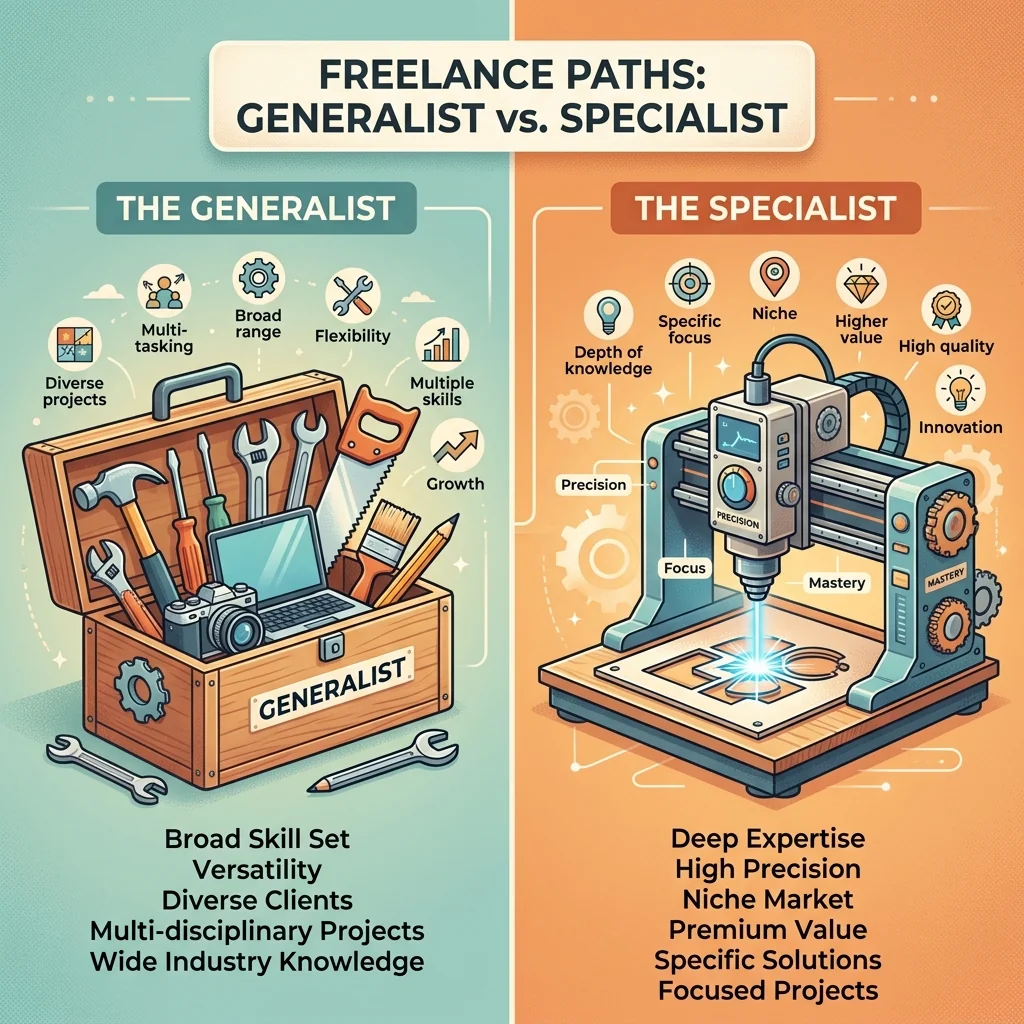
The debate between being a generalist and being a specialist is as old as freelancing itself. In the early days of the web, being a ‘Full-Stack Developer’ was the golden ticket. You could handle everything from the database to the CSS, making you a one-stop shop for any startup. But as we move into 2026, the landscape has shifted. The ‘Stack’ is getting wider, AI is handling more of the ‘grunt work,’ and the market is rewarding depth over breadth.
When I talk to developers about high-value skill selection, I always emphasize that ‘Full-Stack’ is no longer a niche – it’s a baseline. If you want to earn premium rates, you need to layer a specialization on top of that base. Let’s look at why specialization is winning the freelance race and how you can pick the right path for your career.
The Commoditization of the ‘Full-Stack’ Label
A few years ago, calling yourself a ‘Full-Stack Developer’ meant something. It meant you had a rare combination of front-end and back-end skills. Today, millions of developers carry that title. The result? A ‘race to the bottom’ on platforms like Upwork and Fiverr, where ‘Full-Stack’ services are being sold for prices that barely cover the cost of living.
AI has accelerated this commoditization. Tools like GitHub Copilot and Cursor allow any junior developer to output code at a rate that previously required a senior. If your only value is ‘outputting code,’ you are in direct competition with a machine. To survive and thrive in the digital success lane, you must provide value that a machine (and a low-cost generalist) cannot.
The ‘Specialist Premium’: Why Depth Pays More
High-ticket clients don’t have ‘full-stack problems’; they have specific, painful, and expensive problems. A company doesn’t need a ‘React developer’; they need someone who can solve their ‘Real-time Data Visualization Bottleneck.’ A startup doesn’t need a ‘Node.js developer’; they need someone who can secure their ‘Smart Contract Infrastructure.’
By moving from a ‘stack’ focus to a ‘problem’ focus, you move into a world of higher pricing. When you’re one of only a handful of people who can solve a specific problem, the power dynamic shifts in your favor. You’re no longer begging for work; you’re being sought after as an expert. This is the core of niche specialization for freelance success.
The Rise of the ‘Hybrid Specialist’
I’m not saying you should forget your full-stack roots. In fact, having a broad understanding of the entire stack is essential for being a great specialist. It allows you to see the ‘Big Picture’ that a narrow specialist might miss.
I call this the ‘Hybrid Specialist’ model. You have the breadth of a full-stack developer, but the depth of a world-class expert in one specific area. For example, you might be a full-stack developer who specializes in ‘AI-Powered Search Implementation’ or ‘Blockchain-Based Identity Management.’ This hybridity makes you almost irreplaceable. You can talk to the database engineers and the UI designers, but you are the only one who can solve the core specialized problem. This is a perfect example of profitable freelance skills for remote workers.
Identifying High-Scarcity Niches
How do you pick the right niche? I look for ‘Scarcity’ and ‘High Barrier to Entry.’ If a skill can be learned in a weekend, it’s not a niche; it’s a commodity.
Look for areas where the technology is moving so fast that most developers haven’t caught up yet. Areas like AI consulting, cybersecurity for startups, or specialized technical writing are currently in high demand with low supply. Use market research to identify these gaps and position yourself early. According to research from Stack Overflow, specialized roles like Cloud Engineer and Security Expert consistently earn higher salaries and freelance rates than generalist web developers.
The operational efficiency of the Specialist
When you’re a generalist, every project is a ‘new world.’ You have to learn new libraries, set up new environments, and solve new types of bugs. This is incredibly inefficient.
As a specialist, you build a ‘Proprietary System’ for solving your specific problem. You use the same tools, the same frameworks, and the same patterns for every client. This allows you to deliver a 10x better result in 1/10th of the time. You can serve more clients, maintain higher margins, and enjoy a much better work-life balance. This is the dream of the solo digital agency owner.
Building an ‘Authority Engine’ for Your Niche
If you’re a ‘Generalist Developer,’ your portfolio is a list of projects. If you’re a ‘Specialist Expert,’ your freelance portfolio is a collection of case studies proving your expertise in a specific area.
You need to build an ‘Authority Engine’ that consistently proves you are the best person for the job. This includes writing deep-dive technical articles, contributing to specialized open-source projects, and speaking at niche conferences. When a potential client searches for your specialty, you want to be the first name they see. This level of client acquisition is much more effective than cold-bidding on job boards.
Transitioning from Full-Stack to Specialist
You don’t have to quit your current projects to specialize. I recommend a ‘Gradual Pivot’ approach. Start by picking your niche and spending 5-10 hours a week building authority in that space. Update your LinkedIn profile and your Digital Success Lane bio to reflect your new focus.
As you land your first few specialized projects, you’ll find that your confidence (and your rates) will grow. Gradually offboard your generalist clients and replace them with high-ticket specialized ones. Within 6-12 months, you will be known as the ‘Go-To’ person for your niche. It’s a strategic move that will protect your career from the shifting sands of the tech market.
Why ‘Depth’ is the Only Defense Against AI
As we move deeper into 2026, the question on every developer’s mind is ‘will AI take my job?’ The answer depends entirely on where you live in the stack. If you live in the ‘shallow’ end – the area of basic, repeatable coding tasks – then the answer is likely yes.
But if you live in the ‘deep’ end of the stack – where you’re building complex, highly specialized systems that require a high degree of human judgment – then AI is your greatest ally. AI cannot understand the subtle business implications of an architectural decision. It cannot weigh the pros and cons of different cloud providers based on a client’s long-term business goals. Specialization is your durable competitive advantage. It’s the ‘moat’ around your high-ticket business.
Finding Value in High-Scarcity Markets
The most successful independent developers aren’t just technical experts; they are ‘Expert Researchers.’ They are constantly looking for the next ‘Gap’ in the market. Is there a new database technology being adopted by Fintech startups? Is there a new regulatory framework that requires a specific type of data pipeline?
When you identify these gaps early, you can claim the ‘Early-Mover Advantage.’ You can be the first to build authority in that space and the first to command the highest freelance rates. This proactive approach to your professional development is what keeps you at the top of the food chain in the digital success lane.
The operational Efficiency of the Specialist
When you’re a generalist, every project is a ‘new world.’ You have to learn new libraries, set up new environments, and solve new types of bugs. This is incredibly inefficient. As a specialist, you build a ‘Proprietary System’ for solving your specific problem. You use the same tools, the same frameworks, and the same patterns for every client. This allows you to deliver a 10x better result in 1/10th of the time. You can serve more clients, maintain higher margins, and enjoy a much better work-life balance. This is the dream of the solo digital agency owner.
I’ve seen developers thrive by specializing in ‘Legacy System Modernization’ or ‘Cloud Migration for Healthcare.’ These are high-stakes projects where a mistake can cost millions. Because you’ve specialized, you have the checklists, the automated scripts, and the deep knowledge needed to navigate these minefields safely. Your expertise is the client’s insurance policy. This is why a specialist is always more valuable than a generalist in the eyes of a high-ticket buyer.
The ‘One-Person Agency’ is the most profitable business model of the future. It has low overhead, high margins, and total flexibility. If you can stay focused on your niche and relentless about your professional development, you will be unstoppable.
By becoming a specialist, you are filling that gap. You are providing the high-level strategy and technical depth that AI cannot replicate and that generalists cannot provide. You are building a ‘durable’ career in an era of rapid change. Whether you’re interested in AI, security, cloud, or blockchain, the message is the same: find your niche, master it, and own it.
In 2026, the ‘Full-Stack Developer’ is a title. the ‘Specialized Independent Expert’ is a business. Which one do you want to be? I know which path I’ve chosen, and I’ve never looked back. Your journey toward high-ticket specialization starts today. Don’t be afraid to leave the ‘safety’ of the generalist path behind. The real safety is in being the only person who can solve a million-dollar problem.
Full-stack development vs. specialized freelance niches is a debate about the future of your career. While the full-stack path offers broad skills, the specialized path offers deeper value and higher rewards. By identifying a high-scarcity niche and building your authority in that space, you can move away from being a ‘service provider’ and toward being a ‘Strategic Technical Partner.’ Your journey starts here and now.
Leave a Reply