Scaling a business used to be simple: you bought ads, you got traffic, and you hoped some of it converted. But in today’s landscape, that linear model is a recipe for burning through cash. If you want to build something that lasts – something that doesn’t just grow but *scales* – you need to stop thinking about your business as a series of disconnected buckets and start seeing it as a unified engine.
At Digital Success Lane, we talk a lot about the importance of a growth hacking mindset. But that mindset needs a structure to live in. That structure is a full-funnel strategy. It’s the difference between doing random acts of marketing and building a growth machine that learns and improves every single day.
I’ve seen founders spend thousands on client acquisition strategies only to find that their retention is so low that they’re actually losing money on every single customer they bring in. That’s not scaling; that’s just speeding up your failure. Let’s talk about how to do it the right way.
From Funnels to Loops: The New Architecture of Scale
For years, the “funnel” was the gold standard for growth. You’d pour people in at the top (Acquisition), some would trickle down to the bottom (Revenue), and you’d try to make the trickle a little bit bigger. But the problem with a funnel is that it’s inherently losing. You lose people at every stage, and the only way to get more at the bottom is to pour more in at the top.
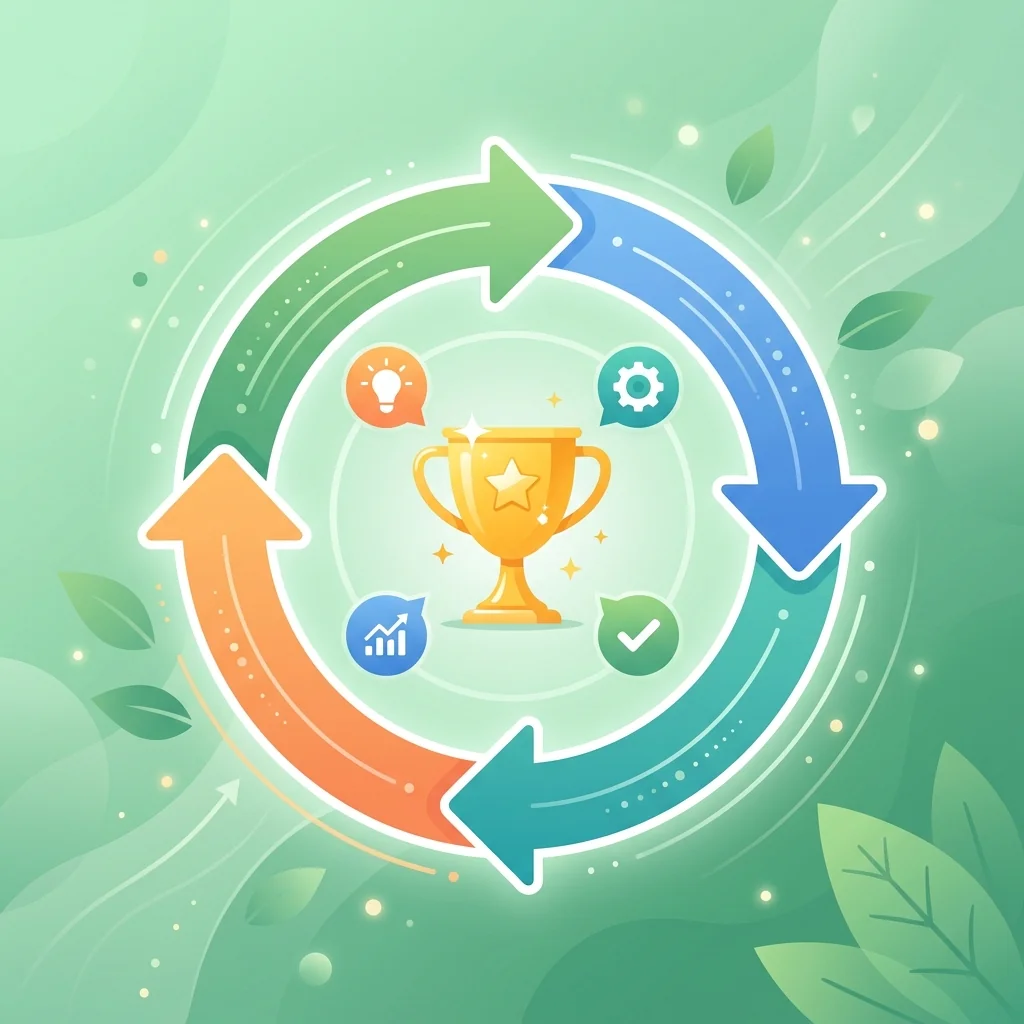
In recent years, the smartest companies have moved toward “Growth Loops.” A loop is different because it’s self-reinforcing. Success in one stage forges the fuel for the next. For example, if your product has a great [Referral] loop, then every new user you acquire at the top of the funnel becomes an acquisition channel for even more users.
This shift from linear to circular thinking is the secret behind the explosive growth of companies like Slack, Dropbox, and Zoom. They didn’t just have a marketing budget; they had a product that grew itself. To understand more about this architecture, I highly recommend checking out this deep dive on how Growth Loops are the New Funnels.
The AARRR Framework: Tracking the Pirate Metrics
Even if you’re building loops, you still need a way to measure the health of your customer journey. This is where the AARRR framework – also known as Pirate Metrics – comes into play. It’s a roadmap developed by Dave McClure that breaks down the user journey into five distinct stages: Acquisition, Activation, Retention, Referral, and Revenue.
1. Acquisition: Quality Over Quantity
Acquisition is about how users find you. In 2026, it’s not just about getting visitors; it’s about getting the *right* visitors. One quality lead is worth more than a thousand “vanity” visitors who bounce within five seconds. Use data-driven frameworks to identify which channels are actually driving long-term value, not just cheap clicks.
2. Activation: The “Aha!” Moment
Activation is the first time a user experiences the core value of your product. If someone signs up for your app but never actually completes their profile or sends their first message, they aren’t activated. Your goal here is to shorten the distance between “I just signed up” and “This is amazing.” For a comprehensive look at how to optimize these stages, read this excellent guide on the AARRR Funnel.
3. Retention: The Engine Room of Scale
I’ve said it before and I’ll say it again: Retention is the most important metric. Sustainable scaling is impossible if you have a “leaky bucket.” If you can’t keep your users, you don’t have a business; you have a revolving door. Focus on building habits and providing continuous value so that users have a reason to stay for months, not just days.
4. Referral: Turning Users into Advocates
A referral loop is the ultimate growth hack. It’s when your existing users become your primary acquisition channel. This doesn’t happen by accident; it’s a result of high satisfaction and a friction-less viral loop built into the product. When you master this, your cost of acquisition (CAC) drops as your growth rate increases.
5. Revenue: The Value Exchange
Finally, you have to make money. But the goal here isn’t just to get the first dollar; it’s to maximize the Lifetime Value (LTV) of the customer. Are you upselling? Are you offering tiered pricing? Are you reducing churn so that the revenue keeps flowing?
Solving the “Leaky Bucket” Syndrome
The biggest mistake I see startups make is focusing exclusively on Acquisition. It’s the shiny, exciting part of growth. You see the traffic graphs go up, and it feels like success. But if your Retention and Activation are broken, you’re just wasting money.
Imagine you spend $10,000 to acquire 1,000 users. If your activation rate is only 10%, you’ve basically paid $100 per activated user. If your churn rate is 20% a month, those users will be gone in five months. If you haven’t made $100 in profit from them by then, you’ve lost money.
Sustainable scaling requires you to fix the leaks *before* you turn on the faucet. Spend your time and energy on high-value skill development within your team so they can build a more robust product and a stickier user experience. Once your retention is healthy and your unit economics make sense, only then should you start aggressively scaling your acquisition.
The Power of the North Star Metric (NSM)
In a full-funnel strategy, there are dozens of metrics you could track. It’s easy to get lost in the sea of data and start chasing numbers that don’t actually matter. To keep your team aligned, you need a North Star Metric.
This is the one metric that best captures the value your product provides to its customers. For Airbnb, it’s not “web traffic”; it’s “nights booked.” When “nights booked” goes up, it means the business is providing more value to both guests and hosts.
Every stage of your AARRR funnel should ultimately serve your North Star Metric. If an acquisition channel is bringing in thousands of users but none of them are booking nights, that channel is a failure, regardless of the traffic numbers. Having this clarity is what allows teams to make the tough decisions about what to cut and where to double down. To see why this matters so much, look at this breakdown of Pirate Metrics: What They Are & Why They Matter.
Building a Unified Growth Team
One of the reasons many companies fail at full-funnel growth is that their teams are siloed. Marketing is in charge of Acquisition, Product is in charge of Retention, and Sales is in charge of Revenue. They have different goals, different managers, and often work in totally different buildings.
This is a recipe for a broken funnel. If Marketing is being judged on “number of leads,” they will bring in a lot of low-quality leads that Product can’t retain and Sales can’t close.
A unified growth strategy requires a unified team. Marketing needs to care about churn. Product needs to care about acquisition friction. Engineering needs to care about conversion rates. When everyone is sharing the same KPIs – and ultimately the same North Star Metric – the barriers between stages start to disappear, and the growth engine starts to hum.
AI-Powered Personalization at Scale
In 2026, full-funnel growth is increasingly being driven by AI. We’re moving away from generic marketing sequences and toward hyper-personalized journeys. Imagine an onboarding flow that changes in real-time based on the user’s behavior, or an email that is sent exactly at the moment when a user is most likely to churn.
AI allows us to manage complexity that was previously impossible. It can analyze thousands of variants of an experiment and tell us which one is working for which specific segment of our audience. This “precision growth” is how small teams are now able to compete with massive corporations – by being smarter, faster, and more personalized than the competition.
The G.R.O.W.S. Process: A Systematic Way to Scale
Finally, you need a process to manage all of this. I recommend the G.R.O.W.S. process, which stands for:
1. Gather Ideas: Brainstorm ideas for every stage of the funnel.
2. Rank: Use your prioritization frameworks to decide what to do first.
3. Outline Experiments: Define your hypothesis and how you’ll measure success.
4. Work: Execute the tests quickly.
5. Study & Scale: Analyze the data and double down on what works.
This isn’t something you do once; it’s a weekly cycle. You’re constantly testing, learning, and refining your growth machine. The more cycles you run, the more proprietary data you have, and the harder it becomes for competitors to catch up to you.
The Road Ahead: Scaling is a Marathon, Not a Sprint
Building a full-funnel growth hacking strategy is hard. It requires a lot of discipline, a lot of data, and a lot of cross-functional collaboration. It’s not as easy as just “running some ads.”
But the reward is a business that grows sustainably. Instead of a series of spikes and crashes, you build a steady, upward trajectory. You build loops that gain momentum over time. You create a customer journey that is so seamless and valuable that your users do your marketing for you.
So, take a look at your funnel. Find the biggest leak. And then – and only then – start figuring out how to pour more people in. The road to scale is paved with retention, not just acquisition. Let’s get building.
Leave a Reply