There’s a massive difference between a tool that answers a question and a tool that finishes a job. If you ask a chatbot to ‘write a blog post,’ you’ll get a draft. If you task an autonomous agent to ‘write, optimize, and publish a blog post,’ you expect a finished URL. Getting from point A to point B isn’t just a matter of adding more words to your prompt; it requires a complete architectural rethink.
At Digital Success Lane, we’ve moved beyond simple prompt engineering. We’re now practicing what I call ‘Agentic Engineering.’ This is the discipline of designing prompts for autonomous AI agents that execute multi-step tasks with high reliability. We’re building systems that can plan, research, execute, and verify their own work for hours at a time. It’s the closest thing to ‘hiring a virtual employee’ that we’ve ever seen. Today, I’m pulling back the curtain on how we build these digital workers and what it means for the future of productivity.
The Shift from Chatbots to Agents: Defining the Mission
When we prompt a chatbot, we’re the director. We give the instructions, wait for the response, and then decide what to do next. We are the ‘glue’ that holds the process together. When we design an agent, we’re the architect. We’re not just giving a task; we’re defining the operational environment, the tools available, and the rules of engagement.
An agent is a long-running process. It exists across multiple ‘turns’ of a conversation and often multiple different ‘sub-agents.’ This means that a small error in step 1 – a missed constraint or a vague instruction – can compound into a catastrophic failure by step 10. Think of it like a space mission: if you’re off by one degree at launch, you’ll miss the moon by a thousand miles. This is why best prompt architecture for minimizing AI hallucinations is the baseline for anything agentic. You have to lock down the facts and the boundaries before you can unleash the autonomy.
Harness Engineering: Building the Agent’s World
The ‘Harness’ is the set of tools and APIs that the agent can interact with. In 2026, we don’t just give an agent a text box; we give it a toolkit. A typical harness for a marketing agent might include access to a Google Search API, a LinkedIn posting API, a Markdown validator, and a database of brand assets.
But the harness isn’t just about ‘access.’ It’s about ‘limits.’ We spend significant time on Permissioning Prompts. We tell the agent: ‘You have read-only access to the database, but you have write-access to the draft folder.’ By explicitly defining what the agent *cannot* do, you prevent it from taking ‘creative shortcuts’ that might be destructive. This is the industrial rigor that moves AI from a toy to a tool. It’s about creating a safe, controlled ‘sandbox’ where the agent can be truly autonomous without risk.
The Orchestrator-Worker Architecture
The biggest mistake I see beginners make is trying to build one giant ‘Super-Agent’ that does everything. They write a five-page system prompt that covers research, coding, writing, and SEO. These agents almost always fail because they become overwhelmed by the sheer number of constraints. They get ‘decision paralysis’ and eventually start ignoring the very rules you set for them.
In 2026, the pros use a modular approach. We use an Orchestrator-Worker model.
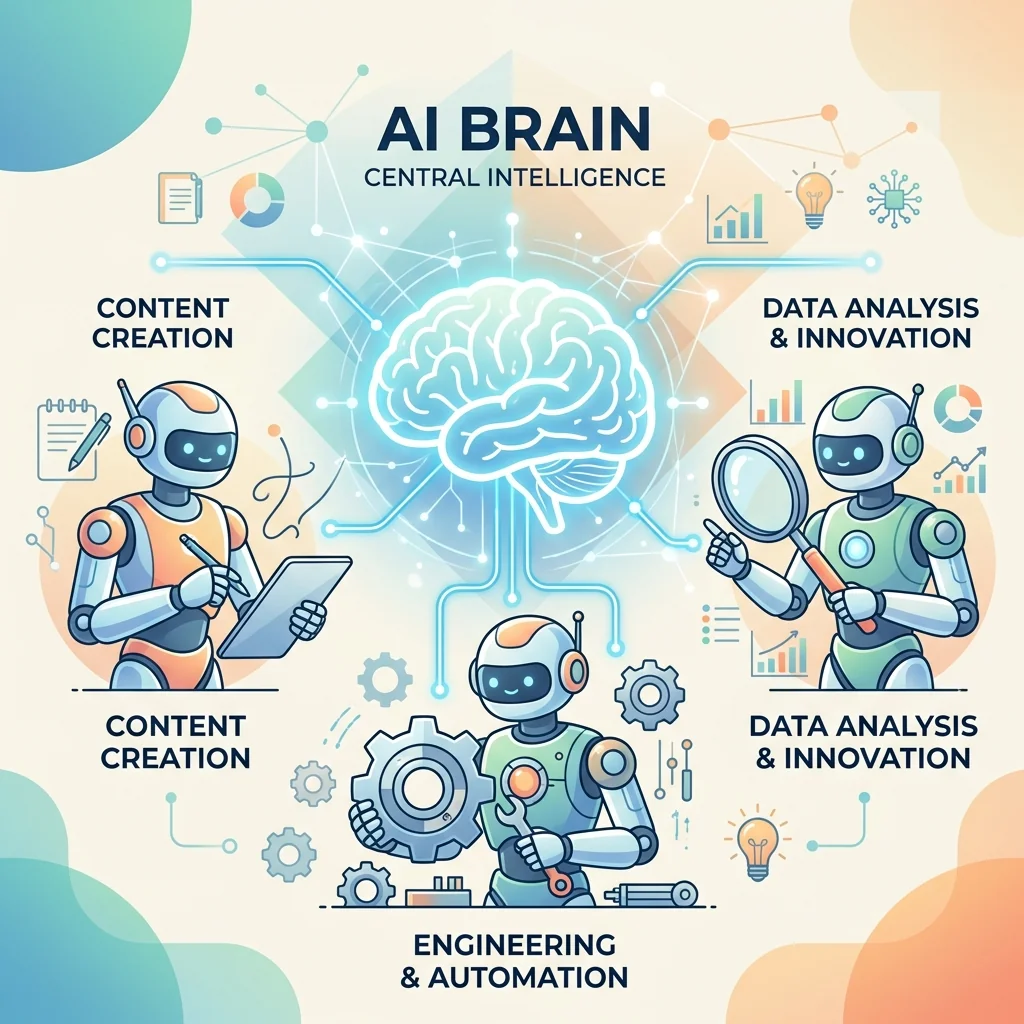
1. The Orchestrator: This agent’s only job is to understand the high-level goal, break it into a logical sequence of sub-tasks (the plan), and delegate those tasks to specialized workers. It is the ‘Manager.’
2. The Workers: These are micro-agents with laser-focused prompts. One worker might be an expert at how to use chain-of-thought prompting for complex reasoning (the Researcher), while another is an expert at SEO formatting (the Editor).
By separating the *planning* from the *executing*, you significantly reduce the ‘cognitive load’ on each individual LLM call. This leads to higher accuracy and more predictable results. It’s like running a business – you wouldn’t ask your lead developer to also handle the payroll and the janitorial services, so why would you ask your AI to do it? Modularity is the path to scaling.
Implementing the ReAct Pattern for Real-Time Correction
If you want an agent to be reliable over a multi-hour task, it needs a way to ‘check its mirror.’ We use the ReAct (Reasoning + Acting) pattern. Instead of the agent just performing an action, it follows a strict loop:
- Thought: ‘I need to find the latest pricing for Product X.’
- Action: `search_web(“Product X pricing 2026”)`
- Observation: [Result from memory/tool]
- Reflection: ‘The search result was old. I need to specify the region in my next search to get the correct GBP pricing.’
This cycle of thinking, acting, and then *observing* the result before the next step is what creates ‘agentic intelligence.’ Without it, the agent is just flying blind. I recommend reading the latest research on agentic orchestration to see how this pattern is transforming how we build businesses. It’s the difference between a robot that hits a wall and a robot that senses the wall and turns. It’s the core of self-correction.
The Non-Negotiable: Structured Communication
In a multi-agent system, the handoff is the danger zone. If Agent A generates a beautiful report but Agent B expected a JSON object, the system crashes. This is where most ‘no-code’ agent tools fail. I cannot stress this enough: All inter-agent communication must be structured.
We enforce strict JSON schemas for every output. Every agent must ‘speak’ in a machine-readable format. This ensures that the data stays clean as it moves through the pipeline. It also allows us to build ‘Validation Gates’ between steps. If Step 2 returns an invalid JSON or a response that fails a custom logic check, the orchestrator stops the process and tells Step 2 to fix it. This automated error correction is how you achieve 99% reliability in complex structured prompts automated marketing content at scale pipelines. You don’t just hope they talk; you force them to talk in a language you can monitor.
Agent Personality and Intent Alignment
We’ve found that giving an agent a ‘Personality’ isn’t just for fun; it actually affects their decision-making. If we tell an agent it is ‘Risk-Averse,’ it will request human approval more often. If we tell it it is ‘Move-Fast-And-Break-Things,’ it will try to find workarounds to obstacles.
Aligning this personality with your business goals is a new form of pricing strategies – balancing speed against accuracy. For research tasks, I want a ‘Pedantic Expert.’ For creative brainstorming, I want an ‘Unfiltered Visionary.’ By carefully tuning the ‘Intent’ section of the prompt, you ensure the agent’s autonomous decisions align with your brand values. It’s about cultural alignment for robots.
Context Hygiene in Long-Running Tasks
Agents generate a lot of data. After ten steps, an agent might have 100,000 tokens of ‘thought process’ in its history. If you just keep feeding that whole history back into the model, you’ll eventually hit the limit or, worse, drown the model in irrelevance. Just as we discussed in how to optimize prompts for long-context windows in Gemini 2.0, hygiene is paramount.
We use ‘Context Compression.’ Every few steps, we have a ‘Summarizer Agent’ take the full history and condense it into a ‘State of the World’ summary. The main agent only gets the current plan and this summary. This keeps the prompt clean, the costs low, and the model’s ‘attention’ focused on the immediate task at hand. It’s like clearing your desk after every phase of a project to focus on the next one.
Designing for Failure: The ‘Safety Valve’ and Confidence Floors
Even the best-designed agents will eventually hit a situation they can’t handle. They’ll get stuck in a ‘Logic Loop’ where they keep trying the same failing action. We design for this using ‘Human-in-the-Loop (HITL) Gates.’
I use a rule called the ‘Confidence Floor.’ When the agent’s internal thought process indicates a low confidence score, or when a high-risk action like a financial transaction or a data deletion is about to occur, the system pauses. It sends an alert to a human, provides a ‘Summary of Intent,’ and waits for a ‘Go’ or ‘No-Go’ confirmation. This is essential for maintaining trust and safety in an autonomous world. You want the agent to do the heavy lifting, but you always want a human to sign the checks.
Observability: Treating Agents Like Software Systems
You can’t debug an agent by just reading its final output. You need to see its ‘Telemetry.’ We use custom logging dashboards to track every single thought/action/observation of our agents in real-time. This is ‘Agent Observability.’ If an agent fails on step 42, we look at the ‘Trace’ to see exactly which decision led to the error.
Was the search result poor? Did it misunderstand a constraint? By treating the prompt as ‘source code’ and the agent as a ‘running service,’ you can apply standard software engineering principles – like unit testing and version control – to your AI operations. This shift in mindset from ‘creative writing’ to ‘systems engineering’ is what defines a professional in 2026.
Summary & Agentic Future: Your Fleet of Digital Workers
Designing prompts for autonomous agents is the highest form of prompt engineering. It combines linguistic precision with architectural foresight. By using orchestrator-worker models, enforcing structured outputs, and building robust self-correction loops, you can create systems that aren’t just ‘helpful’ – they are transformative. They allow you to scale your impact far beyond what you could achieve alone.
We’re moving toward a future where every digital entrepreneur will manage a ‘fleet’ of specialized agents. Those who know how to build the ‘harness’ for these agents will lead the market. The technology is here; the only question is whether you have the structure to handle it. Start small, build modularly, and always keep a human in the loop. The era of the digital worker has begun, and at Digital Success Lane, we’re just getting started. Let’s build something truly autonomous today.
Leave a Reply