In the early 2020s, scaling content typically meant one thing: hiring more freelance writers and full-time editors. If you wanted to move from four articles a week to eight, you simply doubled your budget, your headcount, and your collective coffee consumption. It was a linear, expensive, and often exhausting way to grow a startup brand. But today, we have reached the era of ‘Infinite Content Scaling’ fueled by machine intelligence. With advanced AI, the marginal cost of generating a single raw article has dropped to nearly zero. The challenge today is no longer about production volume; it’s about Authority, Consistency, and Structure Scaling.
If you want to grow your startup’s digital footprint without burning out your core team or diluting your brand’s perceived value in an increasingly crowded market, you need a system that multiplies your impact while dividing your manual effort. You need to learn how to scale content production with pillars. This is the operational evolution of defining your content pillars. Here is the master framework for the future productivity.
The “Pillar-and-Derivative” Model: The Scaling Standard
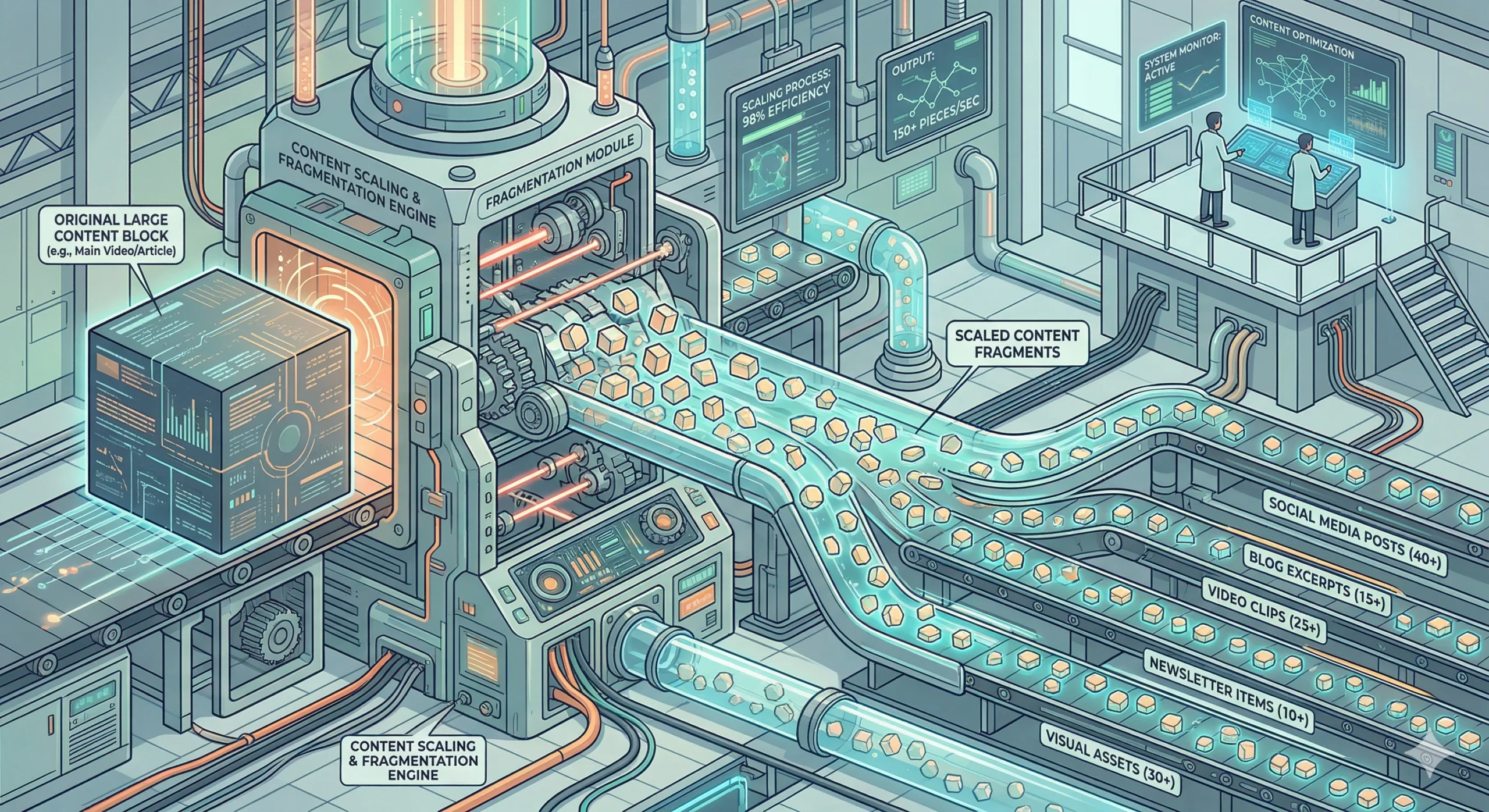
The most effective way to scale in a noisy market is to stop treating every blog post, social update, and newsletter as a unique, one-off creative project that starts from a blank page. Instead, treat them as derivatives of a single, high-authority ‘Atomic’ asset. This model, frequently advocated by experts at the Content Marketing Institute (CMI), is a cornerstone of modern content operations.
1. The Atomic Asset: This is your world-class pillar page or a proprietary, data-rich research report. This is the ‘100% effort’ piece where your brand’s unique insights and technical expertise live.
2. The Derivatives: You then systematically ‘atomize’ that pillar into dozens of smaller, highly specific assets for different platforms.
– A single pillar about ‘B2B Sales Operations’ can become 5-8 cluster blog posts.
– Each cluster post can effortlessly become 3 LinkedIn threads and 1 email newsletter segment.
– The original data-points from the pillar can become 10 high-end infographics for visual platforms like X and Instagram.
Instead of needing 20 distinct great ideas every month, you only need one great foundational idea and a repeatable system to multiply it effectively. This is how you boost your SEO authority while saving 70% of your total production time.
Templates are Your Operational Force Multipliers
Total scaling is impossible if every new task requires a ‘blank page’ brainstorming session. In, high-velocity marketing teams live and die by the quality of their templates. You should have a standardized blueprint for:
- Pillar Briefs: Identifying the right target keywords and search intent before a single word is drafted.
- Brand Voice Governance: Ensuring every derivative sounds like your startup’s unique brand voice regardless of who or what drafted it.
- Repurposing Protocols: Step-by-step instructions on how to turn an article into a video script or an interactive infographic using your content toolstack.
Templates remove the decision fatigue that kills creativity and stalls productivity. They allow your team to move from ‘Manual Creation’ to ‘Systematic Assembly,’ which is significantly faster and more scalable for a growing startup.
AI-Augmented Workflows (Scaling the Heavy Lifting)
In, AI is your ‘Intern of Infinite Scale.’ It should handle the repetitive, manual tasks that used to clog up your production pipeline:
- Research Summarization: Feed your AI co-pilot the raw notes from a subject matter expert and have it generate a detailed, structured outline in seconds.
- Initial Drafting Phase: Have your AI assistant write the ‘First Draft of Everything’ (FDOE) to overcome the horror of the blank page and provide a solid starting point for human refinement.
- Format Conversion Automation: Use AI to turn a long pillar post into a series of punchy social media captions, email body text, or even short video prompts.
By letting AI handle the 70% of the labor that is ‘standard and repeatable,’ your human experts can focus 100% of their energy on the final 30% that actually drives business value: the original insights, the brand storytelling, and the final expert quality control.
Common Scaling Bottlenecks and How to Break Them
As you scale your production, you will inevitably hit ‘friction points’ that slow you down. Identifying them early is key to maintaining high velocity.
1. The Approval Bottleneck: If every single 100-word social post needs the CEO’s or Founder’s final approval, your scale will die on their desk. The Fix: Create exhaustive ‘Voice Guidelines’ and establish ‘Auto-Approval’ criteria for all derivative content based on successful precedents.
2. The Research Bottleneck: Writing stops when the data stops flowing. The Fix: Build a ‘Centralized Research Bank’ or a knowledge base where your team stores proven examples and proprietary data points year-round.
3. The Design Bottleneck: Visuals almost always take longer to produce than text. The Fix: Use AI design tools and ‘Dynamic Templates’ in Canva to turn data into graphics in minutes, not days, ensuring your pillars are always visually rich.
The Pod-Based Production Model for Infinite Scale
For startups with multiple products or distinct customer segments, consider the ‘Pod-Based’ scaling model. A pod is a tiny, fully autonomous team (often just 1 strategist/editor and 1 creator) focused on exactly one content pillar theme. They own that pillar’s growth, its maintenance cycle, and its revenue attribution. This decentralized model allows you to scale simply by adding more pods as you identify new high-value pillars, rather than making your central marketing department more complex and bogged down.
Scaling Without Losing Soul: The Role of the SME Pipeline
The ultimate fix to ‘Generic or Shallow AI Content’ is to build a robust Subject Matter Expert (SME) Pipeline.
- Your sales team, customer success managers, founders, and product leads are your brand’s unique source of truth.
- Interview them for 30 minutes once a month on their core topics of expertise.
- Feed those transcripts into your internal knowledge base for easy retrieval by your content team.
- Use those transcripts as the ‘soul,’ the anecdotes, and the raw material for your entire pillar creation and maintenance strategy. This ensures that even at scale, your content remains remarkably human and grounded in reality.
New Hybrid Roles for the Authority Content Team
If you are hiring for your content team today, look for ‘Hybrid Roles’ that leverage both creative strategy and technical fluency:
- The Content Ops Manager: Responsible for the ‘engine’ – ensuring the templates and measuring success metrics are working correctly across every pod.
- The AI Content Strategist: Responsible for designing the prompts and automated workflows that allow the team to scale output without linearly scaling headcount or costs.
- The Data Storyteller: Responsible for finding the ‘hidden’ original insights in your company’s internal data and turning them into high-authority pillars that your competitors simply cannot replicate.
The Future: Predictive Content Operations in 2027
As we look toward 2027, the best scaling systems will be predictive. Your content ‘engine’ will use performance data to tell you *which* derivative assets to create next based on what is currently trending in your specific niche. By building the structured, pillar-based foundation today, you are preparing your startup for a future where content production is both instant and incredibly high-value.
Checklist for Scaling Your Content Production Engine
Is your startup finally ready to turn up the volume and dominate your niche? Run this scaling readiness audit:
- [ ] Core Pillars Defined: Do you have 3-5 high-authority ‘Hub’ themes to multiply?
- [ ] Repurposing Protocol: Do you have a written workflow for turning 1 pillar into at least 15 logical derivatives?
- [ ] Template Library Audit: Is your brief, draft, and social template library fully documented and accessible to everyone on the team?
- [ ] AI-Assisted Efficiency: Are you using AI for at least 60% of the manual research and drafting labor?
- [ ] SME Routine: Is there a recurring, automated time on the calendar for interviewing your brand’s experts for original stories?
Scaling content isn’t about working harder or throwing more bodies at the problem; it’s about building a better, more intelligent, and more resilient machine. By moving to a pillar-and-derivative model, you are aligning your marketing engine with the way modern audiences consume information – cross-platform, bit-sized, and authoritative. Stop trying to out-publish the generic AI bots and start out-structuring them. Build your ‘Atomic Assets,’ multiply them ruthlessly according to your protocols, and own your industry’s conversation with half the manual effort of your competitors.
FAQ
Can I scale with a team of one or a small bootstrap team?
Absolutely. In, one skilled ‘Content Architect’ using a high-authority toolstack and templates can produce more high-quality, multidimensional content than an entire agency did in 2020. The key is in the system, not the raw headcount.
How do I keep my social media strategy consistent while scaling fast?
Use a ‘Single Source of Truth’ (your pillar page). When all your social posts are derivatives of a single high-authority pillar, they naturally and automatically maintain the same tone, facts, and conclusions across every platform.
Does scaling production too fast hurt my SEO rankings?
Only if the quality drops and your content becomes ‘spammy’ or repetitive. If you produce ‘thin’ content, search engines will catch on. But if your scale is built on the 10x rule, you will only see your domain authority grow faster as you cover more entities.
What is the very first role I should hire when I want to scale my output?
I recommend a Content Operations (Ops) Manager. You need someone who loves systems, templates, and data more than they love ‘pure writing.’ They are the ones who build the ‘factory’ that the writers use to be successful and efficient.
How often should I review and audit my content scaling system?
Run a ‘friction audit’ every 6 months at minimum. Ask your team: ‘Where are we spending the most manual time on things that don’t add strategic value?’ Then, build a template or an AI workflow to solve that specific production bottleneck once and for all.
Leave a Reply