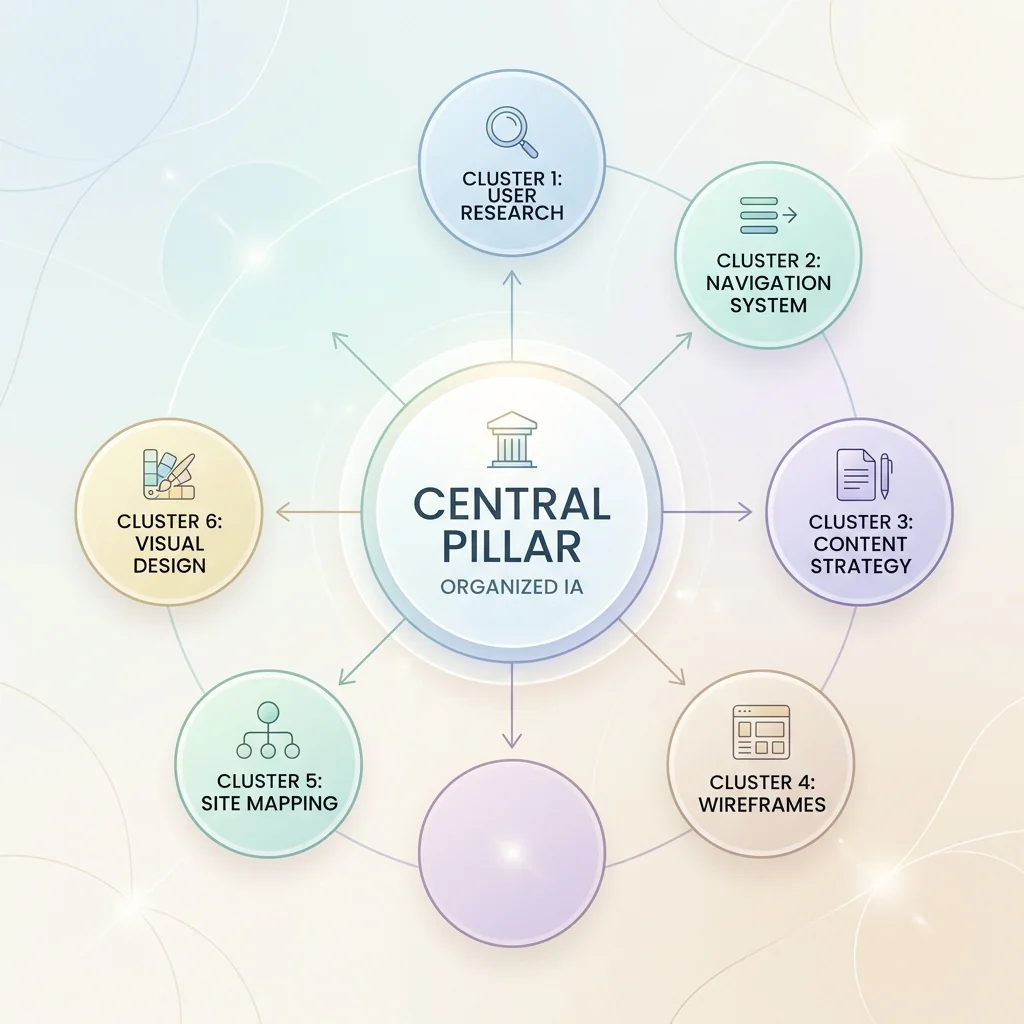
If you’ve spent any time in the marketing world over the last few years, you’ve likely been bombarded with jargon. ‘Topical Authority,’ ‘Entity-Based Search,’ ‘LSI Keywords,’ and of course, the big two: ‘Content Pillars’ and ‘Content Clusters.’ For most startup founders, these terms sounds like different ways to say ‘write a lot of stuff.’ But today, understanding the structural difference between these two isn’t just an academic exercise – it’s the difference between a site that ranks and a site that stays buried on page four while your competitors take all the glory.
Imagine your website is a library. Without a strategy, your blog posts are just a pile of books on the floor. You might have great information, but nobody can find what they need. Content pillars and clusters are your shelves and categories. They organize your knowledge so both humans and search engines can navigate your expertise with ease. When you start defining your content pillars, you are choosing which ‘shelves’ you want to own in the crowded digital marketplace. Here is the definitive guide to the ‘Hub and Spoke’ model and why you need both to win today.
The Content Pillar: The “Hub”
A Content Pillar is the heavyweight champion of your website. It is a single, comprehensive, ‘ultimate guide’ style page that covers a broad subject in massive depth. Think of it as the ‘Level 101’ course for your entire industry. It serves as the primary anchor for your brand’s authority on a specific topic.
- The Goal: To rank for high-volume, competitive ‘head terms.’ These are the broad keywords that hundreds of thousands of people search for. For example, ‘Content Marketing Strategy,’ ‘SaaS Project Management,’ or ‘Artificial Intelligence for Business.’
- The Structure: It typically ranges from 2,000 to 5,000 words. It touches on all the major sub-topics, nuances, and FAQs but doesn’t necessarily go into the ‘nitty-gritty’ details of every single one. It’s the ‘Big Picture’ overview that gives the reader a solid foundation.
- The Visual: This is the center of your wheel – the ‘Hub’ that everything else rotates around.
The Content Cluster: The “Spokes”
A Content Cluster (or Cluster Post) is where the deep-diving and specific problem-solving happens. These are individual, highly focused articles that take one tiny piece of the broad pillar and explore it with surgical precision and depth.
- The Goal: To answer specific, long-tail questions and capture ‘high-intent’ traffic. For example, ‘common mistakes avoiding when setting up content pillars‘ or ‘How to integrate Jira with FlowState.’
- The Structure: These are usually shorter than pillars (1,000 to 2,000 words) and are highly tactical. They solve one specific problem, answer one niche question, or explore one technical nuance in great detail.
- The Visual: These are the ‘Spokes’ radiating out from the hub, providing the necessary support and weight to the overall structure.
The Glue: Why Internal Linking is Non-Negotiable
A pillar and a cluster are just two separate articles until you link them together. Internal linking is the ‘semantic signal’ that tells search engines, ‘These two pieces are related, and together, they provide a complete, authoritative answer to the user’s query.’ Without these links, you just have a collection of orphans.
In, your linking must be bidirectional and deliberate:
1. Pillar → Cluster: The main pillar page links out to all the specific cluster posts. This ‘shares’ the authority, PageRank, and trust of the main page with its supporting cast.
2. Cluster → Pillar: Every cluster post MUST link back to the main pillar page. This signals to search engines that the pillar is the definitive ‘source of truth’ for the topic and helps boost its ranking for those competitive head terms.
3. Cluster ↔ Cluster: When it makes sense contextually, clusters should link to each other. This creates a tight, impenetrable web of information that keeps users on your site longer – increasing your ‘Dwell Time’ and signaling to algorithms that your site is incredibly valuable.
The Competitive Advantage: Topical Authority over Keywords
Why does this structure matter so much today? Because search engines (and the new AI answer engines like Perplexity or Google AI Overviews) have moved entirely away from ‘Keyword Density’ and toward ‘Topical Authority.’ They don’t just want to see a word; they want to see a map of expertise.
An algorithm today doesn’t just look for the word ‘Marketing.’ It looks for a site that explains marketing strategy, marketing budgets, measuring marketing success, and modern marketing tools. By building a pillar with 20 associated clusters, you are proving to the system that you are a comprehensive expert. You are satisfying the ‘E-A-T’ (Expertise, Authoritativeness, and Trust) requirements better than anyone else in your niche. According to research from HubSpot, companies utilizing this model see a significant boost in both organic visibility and lead quality compared to a traditional chronological blog.
How to Build Your First Hub-and-Spoke Model Step-by-Step
Ready to organize your expertise? Follow this 4-step framework to build your first high-authority cluster:
1. Choose Your Head Term: What is the one big, board-level topic you want your brand to be the synonym for? (e.g., ‘Startup Growth’ or ‘Financial Freedom’).
2. Create the Pillar Page: Write the ‘Ultimate Guide to [Your Topic].’ Make it the most comprehensive, easy-to-read resource on the internet for that subject.
3. Brainstorm 10 Cluster Topics: What are the 10 most common specific questions people ask about your topic? Use tools or AI to find these (e.g., ‘Viral Growth Loops,’ ‘Paid Ads for Seed Stage Startups,’ ‘Referral Program Setup’).
4. Link Everything Together: Go back into your pillar and add contextual links to the clusters as you mention those topics. Go into each cluster and ensure they link back to the pillar using the head term as the anchor text.
This systematic process ensures your consistent brand voice is maintained across a whole family of content rather than just a single, isolated piece.
Adapting the Hub-and-Spoke Model for 2027 Answer Engines
As we look toward 2027, the role of clusters will become even more tactical. ‘Answer Engines’ like ChatGPT and Perplexity are becoming the primary way people find information. These engines favor structured, ‘bite-sized’ expertise that they can easily synthesize into a generated answer. By having dozens of small, specific clusters, you are essentially providing ‘API endpoints’ of knowledge for these AI systems. You’re making it easier for them to quote *your* startup as the authority. The Hub-and-Spoke model is no longer just for Google; it’s for the entire AI ecosystem.
Common Misconceptions: AI and Clusters
In, many startups think they can use AI to ‘automatically’ generate a whole cluster in one go. As I noted in the role of AI in content pillar creation, AI is brilliant at building the *structure* of a cluster and suggesting sub-topics, but it cannot provide the *human authority* that makes a cluster valuable. A cluster post about ‘How we solved X problem for Sarah’ must be human-led. AI can give you the blueprint, but only your team can provide the specific case studies, unique insights, and lived ‘truth’ that search engines and humans actually crave.
The difference between content pillars and clusters is the difference between a messy collection of data and a coherent, strategic brand engine. By using the Hub-and-Spoke model, you aren’t just ‘writing more content’; you are ‘building a digital asset.’ You are creating a fortress of authority that is difficult for competitors to copy and incredibly easy for search engines to reward. Start today by taking your best-performing blog post and expanding it into a pillar page. Then, build five tactical spokes around it. Your traffic, your authority, and your audience will thank you for the clarity.
FAQ
Can one article be both a pillar and a cluster?
Technically, yes, if you have a massive, enterprise-level site. A ‘Cluster’ for a huge pillar might become its own ‘Pillar’ for an even deeper sub-topic. For most startups, however, it’s better to keep the roles clear and simple: one broad hub, many narrow and deep spokes.
How many spokes do I really need for a pillar to be effective?
There is no magic number, but most SEO experts recommend starting with a minimum of 5-8 cluster posts to really signal ‘Topical Authority’ to search engines. For highly competitive industries like fintech or healthtech, you might need 30 or more to really dominate.
Should my main pillar page be ungated or gated?
In, the modern best practice is to keep your pillar pages ungated. You want them to be fully accessible to search engine crawlers and easy for your audience to share. You can always ‘gate’ a downloadable PDF version, a related workbook, or a specialized tool *within* the pillar page to capture leads.
Does this Hub-and-Spoke model work for social media too?
Absolutely. You can have a ‘Pillar’ long-form video on YouTube and then create 10 ‘Cluster’ clips for TikTok, Instagram Reels, and LinkedIn that all refer back to the main source. The ‘Hub and Spoke’ philosophy is platform-agnostic and is a cornerstone of any successful social media strategy.
How do I track the performance of a whole cluster instead of just one post?
Group your cluster URLs in your analytics dashboard (like Google Analytics 4) using ‘Content Groups’ to see the total traffic, engagement, and conversions for the entire theme. This gives you a much more accurate picture of your strategic ROI than looking at individual posts in isolation. This is essential for properly measuring success.
Leave a Reply