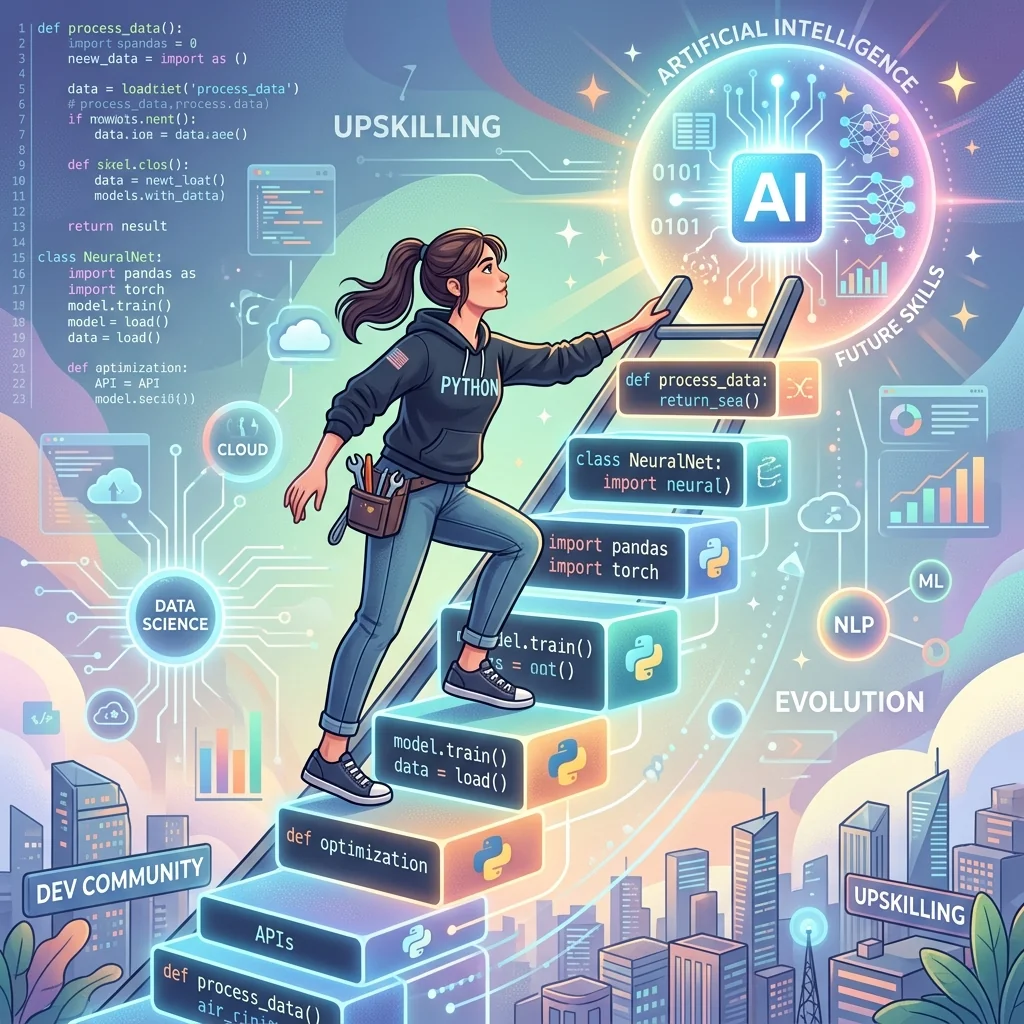
If you have been using Python for a while, you know it’s the ‘Swiss Army Knife’ of the programming world. You can use it for everything from web development to data science to devops. But in the hyper-competitive freelance market of 2026, being a ‘Python Developer’ is no longer enough to command top-tier rates. The world is full of people who can write a basic script. To reach the six-figure level, you need to strategically upskill into high-value, high-complexity roles where your expertise is rare.
When I talk to developers about high-value skill selection, I always say that Python is the perfect foundation. But it’s only the beginning. The real money is in how you *apply* that foundation to solve expensive business problems. Let’s look at the most profitable paths for Python upskilling and how you can make the transition.
## Moving Beyond ‘Glue Code’ to Architecture
Most junior and mid-level Python developers spend their time writing ‘glue code’ – scripts that connect one API to another or move data from a CSV to a database. While this work is necessary, it’s also highly commoditized. AI can already do this remarkably well. In fact, if you’re still primarily a ‘script kiddie’ in 2026, you’re competing directly with free LLMs. To win, you must elevate your perspective.
To increase your value, you must move into ‘Backend Architecture.’ This means mastering asynchronous programming with frameworks like FastAPI or Asyncio. It means understanding how to build distributed systems that can handle millions of requests without breaking. When you can design a system that scales, you are no longer a ‘coder’; you are an ‘Architect.’
This shift involves moving away from simple request-response patterns and toward event-driven architectures. You should be familiar with message brokers like RabbitMQ or Kafka and how Python interacts with them. When you can explain why a specific project should use a microservices approach versus a monolithic one, you are providing senior-level value. This shift is a key part of your journey in the digital success lane. According to Python.org, Python’s strength lies in its ability to integrate with other languages and systems, making it a perfect tool for complex architecture.
## The Explosion of ML Ops and AI Infrastructure
We’ve spend a lot of time talking about AI consulting, but for every AI model, there’s a massive infrastructure that supports it. This is where high-value Python developers live. You’re not just ‘using’ AI; you’re building the systems that allow AI to exist.
High-value Python freelancers are now specializing in ‘LLM Orchestration.’ This involves using tools like LangChain or LlamaIndex to connect large language models to specific business data. You’re building ‘RAG’ (Retrieval-Augmented Generation) pipelines that allow an AI to ‘read’ a company’s internal documents and answer questions accurately. This requires a deep understanding of Vector Databases like Pinecone, Weaviate, or Milvus.
Furthermore, you should be mastering ‘Model Serving’ frameworks. It’s one thing to train a model in a Jupyter Notebook; it’s another thing entirely to serve that model to thousands of users with low latency and high reliability. Tools like BentoML or Ray Serve are becoming essential for the modern AI-focused Python developer. As companies move from ‘AI experimentation’ to ‘AI production,’ the demand for ML Ops experts who know Python is skyrocketing. This is a classic high-paying freelance niche.
## Deep-Dive into Data Engineering and Modern Pipelines
Data is the engine of the modern economy, and Python is the preferred language for moving and refining that data. Upskilling into ‘Data Engineering’ is one of the safest and most lucrative moves a Python developer can make. But the landscape has changed. It’s no longer just about writing ETL (Extract, Transform, Load) scripts.
The ‘Modern Data Stack’ involves tools like Snowflake, BigQuery, and dbt (data build tool). While dbt is primarily SQL-based, Python is the glue that connects the more complex parts of the pipeline. You’ll be working with tools like Apache Airflow or Prefect for orchestration. You’re responsible for ensuring that a company’s data is clean, accessible, and ready for analysis.
In 2026, the ‘Data Engineer’ is often the most important person in a startup. If the data pipeline breaks, the dashboard goes dark, the marketing stops working, and the CEO can’t make decisions. Because of this high cost of failure, businesses pay a massive premium for experts who can build resilient, self-healing data systems. This is a central theme in profitable freelance skills for remote workers.
## Mastering Advanced Python Performance Optimization
Python is often criticized for being ‘slow.’ In 2026, the developers who know how to make Python *fast* are some of the most sought-after experts in the market. This involves mastering advanced techniques like profile-driven development, using C-extensions (like Cython or Pyrex), and optimizing database queries at the ORM level.
You should also be familiar with libraries like NumPy and Pandas for vectorized operations. Often, a ‘slow’ Python script is simply one that isn’t using the right algorithm or library. When you can take a process that used to take ten seconds and make it run in 100 milliseconds, you are providing a tangible ROI to the client. You’re saving them money on server costs and improving their user experience. This level of technical depth is what makes you irreplaceable and allows you to implement value-based pricing. You’re not selling ‘hours of coding’; you’re selling ‘system efficiency.’
## The Rise of the ‘Full-Stack Python’ Specialist with HTMX
While we’ve discussed the full-stack vs specialized niche debate, there’s a growing niche for ‘Full-Stack Python’ specialists who use tools like HTMX and Django or Flask to build highly interactive web applications without the complexity of a separate JavaScript frontend framework like React or Vue.
This ‘Return to Simplicity’ is incredibly appealing to startups who want to move fast and keep their technical debt low. If you can build a complete, production-ready web application using only Python on the server and minimal declarative HTML on the client, you are a one-person powerhouse. You’re effectively cutting the development cost and complexity in half. This is a perfect strategy for a solo digital agency owner who want to offer end-to-end solutions while maintaining a unified, Python-centric stack.
## Python for the Edge and Serverless Computing
In 2026, computer power is moving to the ‘Edge.’ This means running code closer to the user, either on their devices or on decentralized micro-servers. Python’s versatility makes it a strong contender for edge computing, particularly when combined with WebAssembly (Wasm). Tools like PyScript are allowing Python to run directly in the browser.
Furthermore, ‘Serverless’ architectures (AWS Lambda, Google Cloud Functions) are the default for many modern startups. Mastering how to write highly efficient, fast-starting Python functions for these environments is a high-value skill. You need to understand how to manage dependencies in a serverless environment and how to optimize for ‘Cold Starts.’ This specialized knowledge allows you to build systems that cost almost nothing to run but can scale to millions of users instantly.
## Building Your ‘Evidence Engine’ for Advanced Roles
You won’t get hired for high-value architecture roles based on a basic GitHub resume with a few hobby projects. You need to prove you can handle enterprise-grade complexity. This is where your freelance portfolio becomes your most important asset.
Don’t just show ‘working code.’ Show ‘Thinking Process.’ Write deep-dive articles or case studies on how you solved a specific bottleneck, how you designed a multi-region data pipeline, or how you implemented a custom security protocol using Python. Contribute to high-level open-source libraries or even maintain your own small, highly-specialized package. This ‘External Validation’ is what gives six-figure clients the confidence to hire you over a sea of generalist developers.
## The Critical Importance of ‘Soft Skills’ for Senior Roles
As you move into higher-paying roles, your technical skill becomes the ‘Entry Ticket,’ but your soft skills become the ‘Closer.’ Clients paying $150+/hour aren’t just paying for code; they’re paying for technical leadership.
This includes the ability to translate complex technical concepts into business outcomes for non-technical stakeholders. It means being able to lead a team meeting, manage a project timeline, and offer strategic advice that goes beyond the keyboard. I spend as much time on my professional development for communication and leadership as I do for technical upskilling. This is the ‘Senior Perspective’ that separates the freelancers who are struggling from those who are thriving in the digital success lane.
## Why the Python Ecosystem is the Ultimate Freelance Engine
In 2026, the ecosystem around Python is its greatest strength. From the official Python documentation to the millions of packages on PyPI, the resources available to a specialized developer are unprecedented. But this abundance is also a challenge. Most developers are overwhelmed by the options. They try to learn everything and end up mastering nothing.
As a high-value expert, your value isn’t just knowing the tools; it’s knowing which tools NOT to use. It’s about advising the client on the most cost-effective, maintainable, and scalable path forward. I’ve built my career on being a ‘Navigator’ for complex technical decisions. When a client is deciding between a monolithic architecture or a serverless one, they don’t just want a coder to implement it – they want an expert to guide them through the pros and cons based on their business goals.
## Why ‘Code Sustainability’ is the New Benchmark
As AI tools become more prevalent for generating initial code, the bottleneck in software development is shifting. The problem is no longer how fast you can write code, but how well that code is organized, tested, and maintained. High-value Python roles in 2026 require a deep understanding of Clean Code principles, SOLID design patterns, and rigorous automated testing.
I often say that I’m not a ‘Writer of Code’ but a ‘Maintainer of Value.’ Every line of code I write is a liability for the client unless it’s easy to understand and change. By prioritizing sustainability and quality, I’m protecting the client’s investment. This maturity is exactly what high-value clients are looking for in the digital success lane.
## Becoming a ‘T-Shaped’ Python Developer for the Long Haul
The most successful Python freelancers are ‘T-Shaped.’ They have a broad base of knowledge across the entire ecosystem, but they go incredibly deep in one or two specific areas. This combination of breadth and depth makes you versatile enough to handle diverse projects but specialized enough to be the ‘Go-To’ expert for your high-ticket niche.
For example, you might have a broad understanding of the Python web stack, but you are a world-class expert in ‘Python Performance Tuning for Fintech Applications.’ Or maybe you know data science generally, but you are the specialist in ‘AI-Powered Supply Chain Optimization for E-commerce.’
By upskilling now into architecture, ML Ops, or data engineering, you are future-proofing your career. You are moving away from being a ‘service provider’ and toward being a ‘Strategic Technical Partner.’ The demand for this level of partnership is virtually endless. High-value Python upskilling is about moving from the ‘How’ to the ‘Why.’ It’s about combining your technical proficiency with strategic business acumen to solve the world’s most expensive problems. The Digital Success Lane is waiting for those who are willing to go deep.
Leave a Reply